Cosmología con Trazadores de la Estructura a Gran Escala del Universo

Año de inicio
2012
Unidad organizativa

Subvenciones relacionadas:

    General
    Descripción

    El Fondo Cósmico de Microondas (FCM) contiene la información estadística de las semillas primigenias que han dado lugar a la formación de todas las estructuras en el Universo. Su contrapartida natural en el Universo local es la distribución de las galaxias que surgen como resultado del crecimiento gravitatorio de aquellas fluctuaciones de densidad primigenias. La caracterización de la distribución de inhomogeneidades a gran escala en el Universo local proporciona una herramienta muy poderosa, y complementaria al FCM, para determinar el origen y el contenido energético del Universo, el ritmo de expansión del mismo durante la evolución cósmica, los detalles del proceso de formación de todas las estructuras a gran escala que observamos en el Universo hoy día. Esta es la página web del grupo de Cosmología con trazadores de la Estructura a Gran Escala (LSS de sus siglas en inglés), en el IAC.

    Investigador principal
    Personal del proyecto
    1. eBOSS: análisis cosmológico de los datos de cuásares. Marcos Pellejero Ibañez and F. S. Kitaura participaron en la construcción de la likelihood y en el análisis de los parámetros cosmológicos (including as coauthors Kitaura & Pellejero Ibañez: 2018MNRAS.473.4773A).
    2. EUCLID: proyecto comparativo de códigos para generar catálogos de galaxias sintéticos, donde se demostró la precisión y eficiencia de PATCHY (including as coauthors Balaguera-Antolínez, Kitaura & Pellejero Ibañez: https://arxiv.org/abs/1806.09497, https://arxiv.org/abs/1806.09477, https://arxiv.org/abs/1806.09499)
    3. Desarrollo de un método para asignar el bias para estudios de estructura a gran escala (Balaguera-Antolínez, Kitaura, Pellejero Ibañez et al 2018: https://arxiv.org/abs/1806.05870)
    4. Presentación del proyecto UNITSIM para proporcionar modelos teóricos para comparar con observaciones DESI y EUCLID (including as coauthors Kitaura & Pellejero Ibañez:http://www.unitsims.org/ https://arxiv.org/abs/1811.02111)
    5. Presentación del código BARCODE (Bos, Kitaura & Weygaert 2018: https://arxiv.org/abs/1810.05189, http://adsabs.harvard.edu/abs/2018ascl.soft10002B)

    Publicaciones relacionadas

    J-PLUS: Spectroscopic validation of Hα emission line maps in spatially resolved galaxies 2025A&A...695A.200R
    Exploring the physical origins of halo assembly bias from early times 2025A&A...695A.159M
    The J-PAS survey: The effect of photometric redshift errors on cosmic voids 2025A&A...695A.174M
    Multiprobe cosmology from the abundance of SPT clusters and DES galaxy clustering and weak lensing 2025PhRvD.111f3533B
    Calibrating the absolute magnitude of type Ia supernovae in nearby galaxies using [O II] and implications for H<SUB>0</SUB> 2025MNRAS.538..782D
    It is not σ<SUB>8</SUB>: constraining the non-linear matter power spectrum with the Dark Energy Survey Year-5 supernova sample 2025MNRAS.537.3814S
    Galaxy cluster matter profiles: I. Self-similarity, mass calibration, and observable-mass relation validation employing cluster mass posteriors 2025A&A...695A..49S
    Reduction of the type Ia supernova host galaxy step in the outer regions of galaxies 2025MNRAS.538..181T
    The hierarchical growth of bright central galaxies and intracluster light as traced by the magnitude gap 2025MNRAS.538..622G
    Dark Energy Survey Year 3 results: Simulation-based cosmological inference with wavelet harmonics, scattering transforms, and moments of weak lensing mass maps. II. cosmological results 2025PhRvD.111f3504G
    Constraining cosmological parameters using void statistics from the SDSS survey 2025A&A...695A..19F
    Constraints on f(R) gravity from thermal-Sunyaev-Zel'dovich-effect-selected SPT galaxy clusters and weak lensing mass calibration from DES and HST 2025PhRvD.111d3519V
    DESI 2024 VI: cosmological constraints from the measurements of baryon acoustic oscillations 2025JCAP...02..021A
    The Dark Energy Survey Supernova Program: an updated measurement of the Hubble constant using the inverse distance ladder 2025MNRAS.537.1818C
    The construction of large-scale structure catalogs for the Dark Energy Spectroscopic Instrument 2025JCAP...01..125R
    Production of alternate realizations of DESI fiber assignment for unbiased clustering measurement in data and simulations 2025JCAP...01..127L
    Fiducial-cosmology-dependent systematics for the DESI 2024 BAO analysis 2025JCAP...01..144P
    DESI 2024 IV: Baryon Acoustic Oscillations from the Lyman alpha forest 2025JCAP...01..124A
    Evaluating cosmological biases using photometric redshifts for Type Ia Supernova cosmology with the Dark Energy Survey Supernova Program 2025MNRAS.536.1948C
    Milky Way Dark Matter Distribution or MOND Test from Vertical Stellar Kinematics with Gaia DR3 2025ApJ...978...45L
    Dark energy survey year 3 results: cosmology from galaxy clustering and galaxy-galaxy lensing in harmonic space 2025MNRAS.536.1586F
    Dark energy survey year 3 results: likelihood-free, simulation-based wCDM inference with neural compression of weak-lensing map statistics 2025MNRAS.536.1303J
    The baryonic mass estimates of the Milky Way halo in the form of high-velocity clouds 2025NewA..11502328T
    Copacabana: a probabilistic membership assignment method for galaxy clusters 2025MNRAS.536..931E
    Constraints on compact objects from the Dark Energy Survey 5-yr supernova sample 2025MNRAS.536..946S
    LiteBIRD science goals and forecasts. Mapping the hot gas in the Universe 2024JCAP...12..026R
    J-PLUS: The fraction of calcium white dwarfs along the cooling sequence 2024A&A...691A.211L
    J-PLUS: Bayesian object classification with a strum of BANNJOS 2024A&A...691A.221D
    J-PLUS: Beyond Spectroscopy. III. Stellar Parameters and Elemental-abundance Ratios for Five Million Stars from DR3 2024ApJ...974..192H
    Fast simulation mapping: From standard to modified gravity cosmologies using the bias assignment method 2024A&A...690A..27G
    Galaxy Ages with Redshift z = 2–4: Stellar Population Synthesis for Candidates in FourStar Galaxy Evolution Survey 2024ApJ...970..142G
    The Negative Baryon Acoustic Oscillation Shift in the Lyα Forest from Cosmological Simulations 2024ApJ...971L..22S
    The hierarchical cosmic web and assembly bias 2024JCAP...07..083C
    Age of Massive Galaxies at Redshift 8 2024ApJ...970...63L
    The Early Data Release of the Dark Energy Spectroscopic Instrument 2024AJ....168...58D
    CosmoMIA: cosmic web-based redshift space halo distribution 2024JCAP...07..001F
    Bayesian deep learning for cosmic volumes with modified gravity 2024A&A...684A.100G
    The miniJPAS survey: Maximising the photo-z accuracy from multi-survey datasets with probability conflation 2024A&A...684A..61H
    The cosmic web from perturbation theory 2024A&A...683A.215K
    Validation of the Scientific Program for the Dark Energy Spectroscopic Instrument 2024AJ....167...62D

    Congresos relacionados

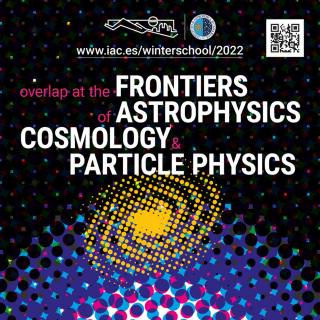
    • Winter School 2022 Poster
      XXXIII Escuela de Invierno de Canarias sobre Astrofísica: Física de Astropartículas y Cosmología
      La XXXIII Canary Islands Winter School of Astrophysics, organizada por el Instituto de Astrofísica de Canarias (IAC), se centra en la Física de Partículas y la Cosmología. La escuela, que se celebrará
      "Salón de actos" del Museo de la Ciencia y el Cosmos (MCC) Avda. Los Menceyes 70 38205 San Cristóbal de La Laguna
      España
      Fecha
      -
      Anteriores