Astrofísica de Partículas

    General
    Descripción

    El Grupo de Astrofísica de Partículas del IAC participa activamente en tres grandes colaboraciones internacionales de astrofísica de muy altas energías: AMS-02 (Alpha Magnetic Spectrometer), los telescopios de radiación Cherenkov MAGIC I y II y el Cherenkov Telescope Array Observatory (CTAO). Además, participamos en el ASTRI mini-array, el experimento de rayos gamma Fermi-LAT y los telescopios ópticos de seguimiento de ondas gravitacionales GOTO.

    AMS-02 es un detector de partículas diseñado para operar en el espacio, a bordo de la Estación Espacial Internacional (ISS). Se instaló con éxito en mayo de 2011, y se espera que opere durante toda la vida útil de la misma hasta al menos 2030. Su misión es realizar un estudio de alta precisión y estadística del espectro y la composición de los rayos cósmicos primarios en un amplio rango de energía, así como buscar antimateria primordial y materia oscura de forma indirecta. 

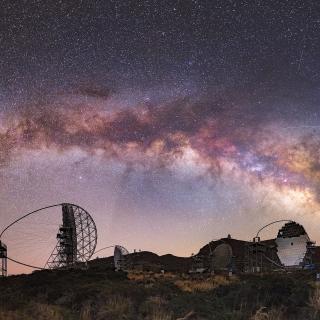
    La colaboración MAGIC está formada por 20 institutos y departamentos universitarios de Alemania, Armenia, Bulgaria, España, EEUU, Finlandia, Italia, Polonia y Suiza. La colaboración cuenta con dos telescopios de 17 m de diámetro localizados en el Obsevatorio del Roque de los Muchachos (ORM), diseñados para medir la radiación Cherenkov asociada a cascadas atmosféricas producidas por rayos gamma de muy alta energía y localizados en el Observatorio del Roque de los Muchachos. 

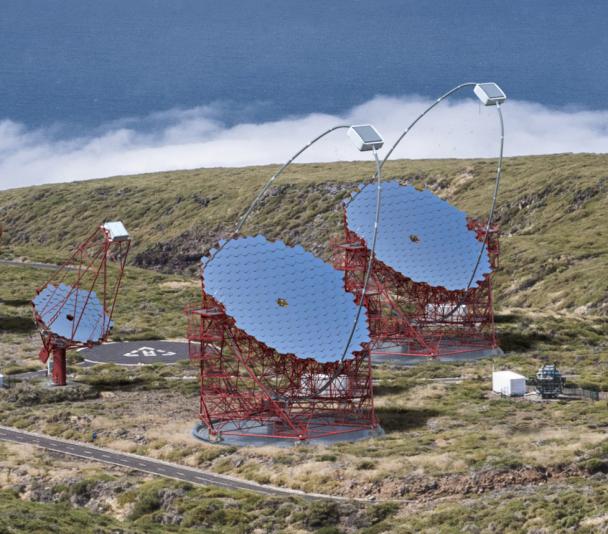
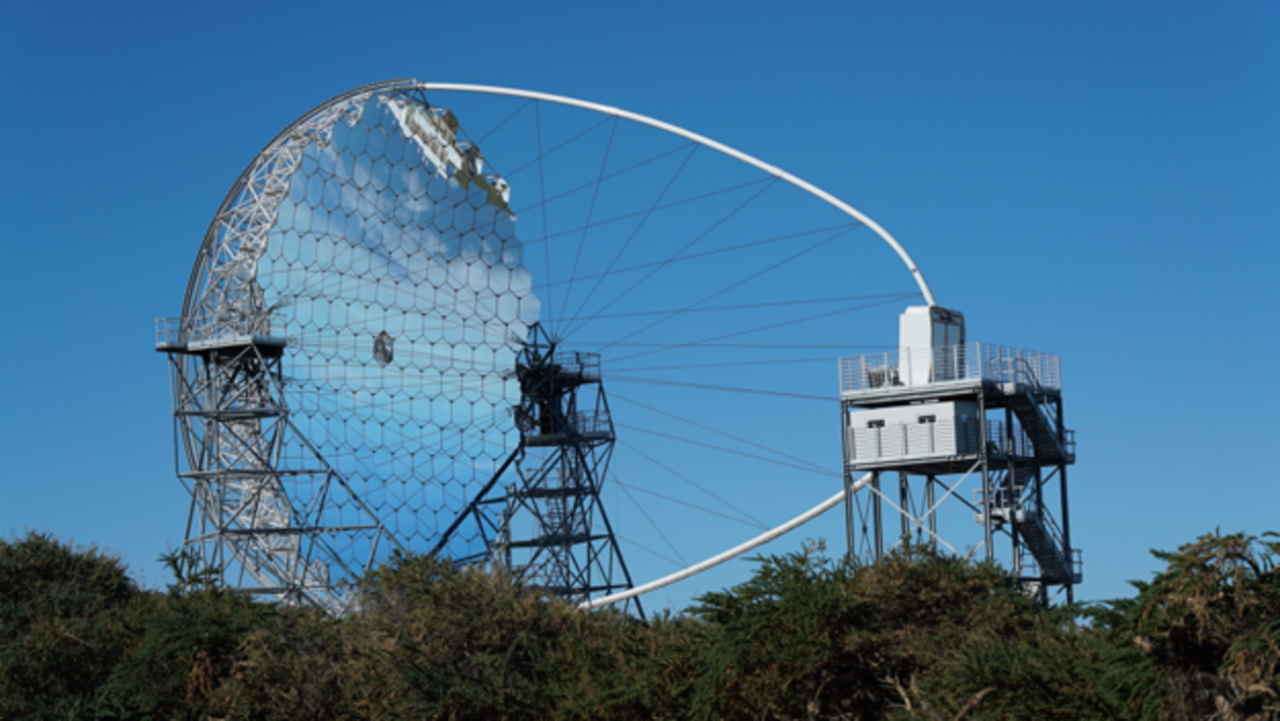
    En el marco de las observaciones de rayos gamma de muy alta energia, el IAC también participa en el consorcio internacional de la red de telescopios Cherenkov CTAO, cuyo objetivo es construir dos grandes complejos de observación en los hemisferios Norte y Sur. El Observatorio del Roque de los Muchachos en La Palma fue seleccionado para albergar el observatorio Norte de CTAO. El primer telescopio de 23 metros del tipo "Large Size Telescope" de CTAO, denominado LST1, fue inaugurado en el ORM en octubre de 2018. Este telescopio ha sido construido por el consorcio "LST Collaboration" de CTAO, que está integrado por 300 científicos de 12 países, donde el IAC tiene un papel muy relevante. Actualmente se está finalizando la puesta a punto del telescopio LST1 y la explotación científica de los datos ya está dando lugar a nuevos descubrimientos. El IAC está actualmente en fase de construcción de 3 telescopios de gran tamaño más (LST2-LST4) en el ORM.

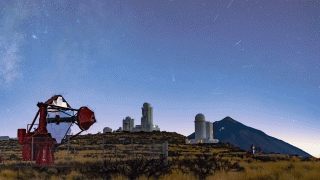
    El proyecto ASTRI mini-array está actualmente en construcción en el Observatorio del Teide. Consistirá en un total de 9 telescopios Cherenkov de pequeño tamaño, de los cuales el primero, ASTRI-1, está ya construido y en fase de comisionado.

    Investigador principal
    Co investigador principal
    Colaboradores

    Publicaciones relacionadas

    Catalog of Long-term Transient Sources in the First 10 yr of Fermi-LAT Data 2021ApJS..256...13B
    First detection of VHE gamma-ray emission from TXS 1515-273, study of its X-ray variability and spectral energy distribution 2021MNRAS.507.1528A
    Properties of a New Group of Cosmic Nuclei: Results from the Alpha Magnetic Spectrometer on Sodium, Aluminum, and Nitrogen 2021PhRvL.127b1101A
    Multiwavelength variability and correlation studies of Mrk 421 during historically low X-ray and γ-ray activity in 2015-2016 2021MNRAS.504.1427A
    H.E.S.S. and MAGIC observations of a sudden cessation of a very-high-energy γ-ray flare in PKS 1510‒089 in May 2016 2021A&A...648A..23H
    VHE gamma-ray detection of FSRQ QSO B1420+326 and modeling of its enhanced broadband state in 2020 2021A&A...647A.163M
    Properties of Heavy Secondary Fluorine Cosmic Rays: Results from the Alpha Magnetic Spectrometer 2021PhRvL.126h1102A
    Electron-beam interaction with emission-line clouds in blazars 2021A&A...646A.115W
    The Alpha Magnetic Spectrometer (AMS) on the international space station: Part II - Results from the first seven years 2021PhR...894....1A
    MAGIC Observations of the Nearby Short Gamma-Ray Burst GRB 160821B 2021ApJ...908...90A
    Properties of Iron Primary Cosmic Rays: Results from the Alpha Magnetic Spectrometer 2021PhRvL.126d1104A
    A search for optical and near-infrared counterparts of the compact binary merger GW190814 2020MNRAS.499.3868T
    Detection of the Geminga pulsar with MAGIC hints at a power-law tail emission beyond 15 GeV 2020A&A...643L..14M
    MAGIC observations of the diffuse γ-ray emission in the vicinity of the Galactic center 2020A&A...642A.190M
    HORuS transmission spectroscopy of 55 Cnc e 2020MNRAS.498.4222T
    Testing two-component models on very high-energy gamma-ray-emitting BL Lac objects 2020A&A...640A.132M
    Properties of Neon, Magnesium, and Silicon Primary Cosmic Rays Results from the Alpha Magnetic Spectrometer 2020PhRvL.124u1102A
    Studying the nature of the unidentified gamma-ray source HESS J1841-055 with the MAGIC telescopes 2020MNRAS.497.3734M
    Bounds on Lorentz Invariance Violation from MAGIC Observation of GRB 190114C 2020PhRvL.125b1301A
    An intermittent extreme BL Lac: MWL study of 1ES 2344+514 in an enhanced state 2020MNRAS.496.3912M
    Broadband characterisation of the very intense TeV flares of the blazar 1ES 1959+650 in 2016 2020A&A...638A..14M
    Optical spectral characterization of the TeV extreme blazar 2WHSP J073326.7+515354 2020MNRAS.494.6036B
    Study of the variable broadband emission of Markarian 501 during the most extreme Swift X-ray activity 2020A&A...637A..86M
    Broad-band spectral energy distribution of the X-ray transient Swift J1745-26 from outburst to quiescence 2020A&A...637A...2C
    The Fourth Catalog of Active Galactic Nuclei Detected by the Fermi Large Area Telescope 2020ApJ...892..105A
    A search for dark matter in Triangulum II with the MAGIC telescopes 2020PDU....2800529A
    MAGIC very large zenith angle observations of the Crab Nebula up to 100 TeV 2020A&A...635A.158M
    Fermi Large Area Telescope Fourth Source Catalog 2020ApJS..247...33A
    New Hard-TeV Extreme Blazars Detected with the MAGIC Telescopes 2020ApJS..247...16A
    The Great Markarian 421 Flare of 2010 February: Multiwavelength Variability and Correlation Studies 2020ApJ...890...97A
    Quasi-periodic behaviour in the optical and γ-ray light curves of blazars 3C 66A and B2 1633+38 2020MNRAS.492.5524O
    Monitoring of the radio galaxy M 87 during a low-emission state from 2012 to 2015 with MAGIC 2020MNRAS.492.5354M
    Statistics of VHE γ-rays in temporal association with radio giant pulses from the Crab pulsar 2020A&A...634A..25M
    Properties of Cosmic Helium Isotopes Measured by the Alpha Magnetic Spectrometer 2019PhRvL.123r1102A
    Observation of inverse Compton emission from a long γ-ray burst 2019Natur.575..459M
    Towards Understanding the Origin of Cosmic-Ray Electrons 2019PhRvL.122j1101A
    Towards Understanding the Origin of Cosmic-Ray Positrons 2019PhRvL.122d1102A
    Teraelectronvolt emission from the γ-ray burst GRB 190114C 2019Natur.575..455M
    Testing emission models on the extreme blazar 2WHSP J073326.7+515354 detected at very high energies with the MAGIC telescopes 2019MNRAS.490.2284M
    Constraints on Gamma-Ray and Neutrino Emission from NGC 1068 with the MAGIC Telescopes 2019ApJ...883..135A
    Proyectos relacionados
    Simulación del observatorio CTAO Norte. Crédito: Gabriel Pérez Díaz (IAC)
    IACTEC Grandes Telescopios: Cherenkov Telescope Array Observatory - CTAO
    CTAO es un proyecto global a gran escala para construir una nueva generación de telescopios Cherenkov dedicada al estudio del universo en rayos gamma de muy alta energía. Los rayos gamma contienen información sobre los eventos más violentos y extremos del Cosmos.
    Ramón
    García López