Pequeños Cuerpos del Sistema Solar

    General
    Descripción

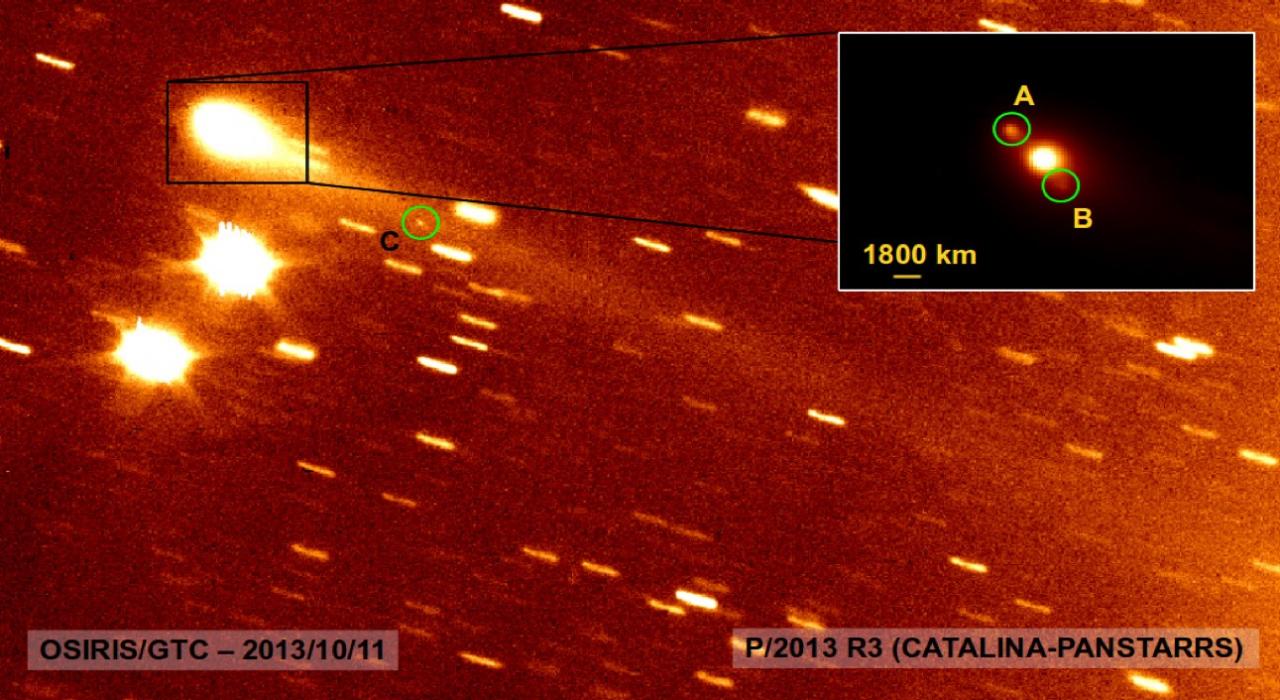
    Este Proyecto estudia las propiedades físicas y composicionales de los llamados pequeños cuerpos del Sistema Solar, que incluyen asteroides, objetos helados y cometas. Entre los grupos de mayor interés destacan los objetos trans-neptunianos (TNOs), incluyendo los objetos más lejanos detectados hasta la fecha (Extreme-TNOs o ETNOs); los cometas, y los objetos transicionales cometa-asteroide (Centauros y los llamados Main Belt Comets - MBCs); los asteroides primitivos. Los dos últimos grupos contienen el material más primordial y prístino del Sistema Solar son claves para comprender su origen y evolución. Se destacan entre los asteroides aquellos que se acercan a la órbita de la Tierra (near-Earth asteroids o NEAs), así como los considerados potencialmente peligrosos (Potentially Hazardous Asteroids o PHAs). Debido a su cercanía, los NEAs son los objetos más accesibles al estudio in-situ con misiones espaciales y su futura explotación como fuente de materias primas (asteroid mining). Se destaca el liderazgo por parte del IP del grupo de un survey espectroscópico (visible e infrarrojo cercano) de asteroids primitivos (PRIMitive Asteroid Spectroscopic Survey - PRIMASS). Este proyecto ha recibido financiación de la NASA (17-PDART17_2-0097, IP: N. Pinilla-Alonso, 137.000€ - 2 años) para archivar todos estos espectros (más de 800) en el Small Bodies Node del NASA Planetary Data System.

    Los estudios de composición superficial y propiedades físicas y térmicas de estos cuerpos se llevan a cabo utilizando espectroscopia en un amplio rango de longitudes de onda (desde 0.35 a 24 micras), así como imagen y fotometría en el mismo rango. Los datos se interpretan utilizando modelos de scattering y termo-físicos. El proyecto trabaja además en el análisis de las propiedades físicas de los núcleos cometarios y de las propiedades del polvo y el gas en las comas cometarias, muy especialmente en el estudio del polvo en las colas de los MBCs y de los mecanismos por los cuales se emite.

    Este grupo mantiene diversas colaboraciones internacionales con otros grupos entre las que podemos destacar: (1) la pertenencia al Grupo de Ciencia de la misión de NASA OSIRIS-REx, en concreto al "Image Processing Working Group", en donde se encarga del tratamiento de los mapas de color que se están obteniendo actualmente con las cámaras OCAMS; (2) la pertenencia al núcleo central de proponentes de las misiones M5 de ESA CASTALIA, CASTAway y Hera; (3) la coordinación de un grupo internacional de estudio de NEAs llamado EURONEAR (European Near Earth Asteroid Research); (4) la pertenencia al "Center for Lunar and Asteroid Surface Science" (CLASS, NASA); (5) la integración en el grupo de Sistema Solar de la misión Euclid; (6) la participación activa en los surveys J-PLUS y J-PASS, en los que trabaja en la explotación de las observaciones de objetos del Sistema Solar; (7) la pertenencia a los grupos de trabajo de Sistema Solar de los telescopios Gaia y JWST.
    Investigador principal
    Gestor del proyecto
    Personal del proyecto
    Colaboradores
    Dr.
    Noemí Pinilla-Alonso
    Dr.
    Humberto Campins
    Dr.
    Fernando Moreno Danvila
    Dr.
    Y. Fernández
    Dr.
    José Luis Ortiz
    Dr.
    R. Duffard
    Prof.
    R. Hil-Hutton

    Publicaciones relacionadas

    The active centaur 2020 MK<SUB>4</SUB> 2021A&A...649A..85D
    The EURONEAR Lightcurve Survey of Near Earth Asteroids—Teide Observatory, Tenerife, 2015 2021EM&P..125....3V
    Alignment determination of the Hayabusa2 laser altimeter (LIDAR) 2021EP&S...73...21N
    Bennu's global surface and two candidate sample sites characterized by spectral clustering of OSIRIS-REx multispectral images 2021Icar..36414467R
    Numerical modeling of lander interaction with a low-gravity asteroid regolith surface. II. Interpreting the successful landing of Hayabusa2 MASCOT 2021A&A...648A..56T
    Improved method of hydrous mineral detection by latitudinal distribution of 0.7-μm surface reflectance absorption on the asteroid Ryugu 2021Icar..36014348K
    Post-arrival calibration of Hayabusa2's optical navigation cameras (ONCs): Severe effects from touchdown events 2021Icar..36014353K
    Photometry of asteroid (101955) Bennu with OVIRS on OSIRIS-REx 2021Icar..35814183Z
    Disk-resolved photometric modeling and properties of asteroid (101955) Bennu 2021Icar..35713724G
    Near-infrared spectroscopy of the Sulamitis asteroid family: Surprising similarities in the inner belt primitive asteroid population 2021Icar..35814210A
    Collisional history of Ryugu's parent body from bright surface boulders 2021NatAs...5...39T
    Exogenic basalt on asteroid (101955) Bennu 2021NatAs...5...31D
    Spectral characterization of the craters of Ryugu as observed by the NIRS3 instrument on-board Hayabusa2 2021Icar..35714253R
    Near-infrared spectroscopy of the Chaldaea asteroid family: Possible link to the Klio family 2021Icar..35414028A
    Variations in color and reflectance on the surface of asteroid (101955) Bennu 2020Sci...370.3660D
    Crater depth-to-diameter ratios on asteroid 162173 Ryugu d/D of craters on Ryugu 2021Icar..35414016N
    Hayabusa2 Landing Site Selection: Surface Topography of Ryugu and Touchdown Safety 2020SSRv..216..116K
    A comparative analysis of the outer-belt primitive families 2020A&A...643A.102D
    Spectral characterisation of 14 V-type candidate asteroids from the MOVIS catalogue 2020A&A...643A.107M
    Dozens of virtual impactor orbits eliminated by the EURONEAR VIMP DECam data mining project 2020A&A...642A..35V
    The GAPS programme at TNG. XXIV. An eccentric Neptune-mass planet near the inner edge of the BD-11 4672 habitable zone 2020A&A...641A..68B
    Spin-driven evolution of asteroids' top-shapes at fast and slow spins seen from (101955) Bennu and (162173) Ryugu 2020Icar..35213946H
    Global photometric properties of (162173) Ryugu 2020A&A...639A..83T
    Restoring the night sky darkness at Observatorio del Teide: First application of the model Illumina version 2 2020MNRAS.497.2501A
    Physical characterization of 2020 AV<SUB>2</SUB>, the first known asteroid orbiting inside Venus orbit 2020MNRAS.496.3572P
    Sample collection from asteroid (162173) Ryugu by Hayabusa2: Implications for surface evolution 2020Sci...368..654M
    Highly porous nature of a primitive asteroid revealed by thermal imaging 2020Natur.579..518O
    IGAPS: the merged IPHAS and UVEX optical surveys of the northern Galactic plane 2020A&A...638A..18M
    Visible and near-infrared observations of interstellar comet 2I/Borisov with the 10.4-m GTC and the 3.6-m TNG telescopes 2020MNRAS.495.2053D
    Characterization of the June epsilon Ophiuchids meteoroid stream and the comet 300P/Catalina 2020A&A...636A.122M
    An artificial impact on the asteroid (162173) Ryugu formed a crater in the gravity-dominated regime 2020Sci...368...67A
    The spatial distribution of impact craters on Ryugu 2020Icar..33813527H
    Analysis in the visible range of NASA Lucy mission targets: Eurybates, Polymele, Orus and Donaldjohanson. 2020Icar..33813463S
    The spectroscopic properties of the Lixiaohua family, cradle of Main Belt Comets 2020Icar..33813473D
    An ultra-short period rocky super-Earth orbiting the G2-star HD 80653★ 2020A&A...633A.133F
    Microquasar V404 Cyg /GS 2023+338: MASTER optical observations during the June and December 2015 super-outbursts 2019NewA...72...42L
    The MASTER Global Robotic Telescope Network: Observations of Asteroid NEA 2015 TB145 2019ARep...63.1056Z
    The descent and bouncing path of the Hayabusa2 lander MASCOT at asteroid (162173) Ryugu 2019A&A...632L...3S
    The MASCOT landing area on asteroid (162173) Ryugu: Stereo-photogrammetric analysis using images of the ONC onboard the Hayabusa2 spacecraft 2019A&A...632L...4P
    Episodes of particle ejection from the surface of the active asteroid (101955) Bennu 2019Sci...366.3544L