
The Instituto de Astrofísica de Canarias (IAC), through the European UNDARK project and together with CERN, has brought together international experts in cosmology, astrophysics and theoretical physics to analyse some of the discrepancies that are challenging our current understanding of the Universe. The aim is to determine whether they arise from effects in the observations that are not yet fully understood, or whether they conceal unknown physical phenomena still waiting to be discovered.
We know more about the Universe than at any other time in history, and we can measure some of its properties with extraordinary precision. Yet the more closely we look, the more we encounter measurements that do not quite fit together.
Are we measuring something incorrectly, or are we beginning to see the first signs of physics that we do not yet understand?
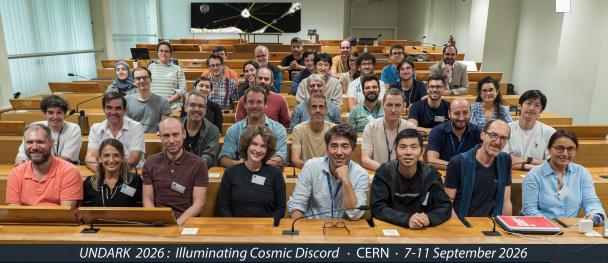
This question was at the heart of “UNDARK 2026: Illuminating Cosmic Discord,” held at CERN from 7 to 11 September. Organised by the Instituto de Astrofísica de Canarias (IAC) through the European UNDARK project, together with CERN, the five-day meeting brought together different observational and theoretical perspectives to examine some of the major tensions in modern cosmology.
The aim was precisely to combine two complementary approaches. The IAC contributed its expertise in cosmology, astrophysics, and observations, while CERN brought its perspective from fundamental physics and theoretical cosmology. According to Jorge Martín Camalich, IAC researcher and coordinator of UNDARK, understanding whether the current discrepancies represent a breakdown of the cosmological model or arise from systematic effects requires bringing these two perspectives together.
When precision begins to reveal the cracks
Cosmology has entered an era in which the standard cosmological model, known as ΛCDM, is being subjected to experimental and observational tests that, in some cases, reach a precision of around 1%. This is what is known as precision cosmology.
And this is precisely where, Camalich explains, the most interesting questions begin to emerge: “At this frontier, we are beginning to see the seams of the model coming apart.”
This does not mean that ΛCDM has stopped working. On the contrary, the model has been enormously successful in describing the evolution of the Universe. The question is what the discrepancies that emerge as observations reach ever higher levels of precision actually mean.
One possibility is that there are still systematic errors or astrophysical phenomena that we do not understand well enough and that are affecting the interpretation of observations. But there is another, much deeper possibility: that several of these discrepancies reflect a common pattern and are pointing towards a new description of the Universe.
For Camalich, this represents a particularly fertile frontier for science: “When we reach that point, things begin to appear that we do not understand. And that is precisely where we want to be, because that is where we can learn new things.”
Measurement errors or new physics?
Answering this question requires progress along two paths simultaneously. The first is to measure better: reviewing instruments, experiments, catalogues and astrophysical systems to identify possible uncertainties. The second is to ask what would happen if some of these tensions were real, and to search for extensions of the cosmological model capable of explaining them.
But discovering new physics is not simply a matter of constructing a theory that explains an anomaly. Any new explanation would also have to be consistent with the rest of the observations and, above all, make new predictions that could be tested experimentally. If one of those predictions anticipated a phenomenon that had not yet been observed and was subsequently confirmed, Camalich points out, then we would be facing a discovery.
Among the signals he considers particularly interesting is possible cosmic birefringence, a rotation in the polarisation of the oldest light in the Universe. If its cosmological origin were confirmed, it could open new horizons in our understanding of the cosmos.
And the consequences could reach the very heart of UNDARK. Although ΛCDM describes the Universe extraordinarily well, it contains two components whose fundamental nature remains unknown: dark matter and dark energy.
Camalich suggests that, just as ordinary matter has left observable traces throughout the cosmos, the dark Universe may have left its own. Some could manifest themselves in cosmic expansion or may have been imprinted on the cosmic microwave background, the oldest light we can observe. Some of the current anomalies could therefore become an opening through which we begin to understand what dark matter or dark energy really are.
Is dark energy changing, or do we need better measurements?
One of the examples that best captured this dilemma during the meeting was presented by George Efstathiou, from the University of Cambridge.
Recent DESI results have raised a possibility with far-reaching implications: that dark energy, associated with the accelerated expansion of the Universe, may not be constant but instead evolve over time.
Efstathiou focused on a fundamental question: before concluding that we are seeing new physics, we must make sure that the differences do not originate in our own measurements. DESI data on their own are consistent with the current model of the Universe. However, when combined with certain supernova observations, the possibility emerges that dark energy may be changing over time. The problem is that this signal varies depending on which supernova dataset is used.
The case perfectly illustrates the challenge currently facing cosmology: an extremely small difference in observations can change the physical interpretation we make of the Universe.
That is why, before proclaiming a revolution, science must rule out the possibility that these differences arise from calibrations, samples or systematic effects that are not yet fully controlled. But if the signal persists as precision improves and different independent observations converge in the same direction, the situation would be very different.
Artificial intelligence enters the discovery process
If new observations are pushing cosmology to its limits, new tools may also change the way we search for answers.
Francisco Villaescusa-Navarro, a researcher at the Simons Foundation and Princeton University, presented at CERN the potential of artificial intelligence agents applied to scientific research.
These systems can already participate in tasks ranging from searching and synthesising scientific literature to generating hypotheses, designing experiments, programming, analysing data, interpreting results and subjecting them to critical review.
Villaescusa-Navarro presented Denario, a system based on collaboration between multiple specialised agents. The proposal is not simply to use AI to process enormous amounts of data, but to explore how it can participate in different stages of the scientific process itself.
This perspective opens up important possibilities for highly complex problems such as those addressed by cosmology: accelerating certain research processes, exploring large spaces of hypotheses and helping to detect connections that are difficult to identify using traditional methods.
But the presentation also introduced a fundamental limit: AI should enhance human capabilities, not replace them, and responsibility for the use of these technologies must remain with scientists.
A Universe that does not quite add up
The contributions from Efstathiou and Villaescusa-Navarro formed part of a much broader scientific picture. Over five days, UNDARK 2026 explored different pieces of the Universe that we are trying to understand with unprecedented precision.
Licia Verde, ICREA Professor at the Institute of Cosmos Sciences of the University of Barcelona, addressed one of the best-known discrepancies: the Hubble tension. The current expansion rate of the Universe can be inferred by studying the early cosmos through the cosmic microwave background, or measured using relatively nearby objects such as Cepheids and supernovae. The two approaches do not yield exactly the same result.
Mickael Rigault showed why Type Ia supernovae, which are fundamental for measuring vast distances and reconstructing cosmic expansion, require extraordinarily precise control. Instrument calibration, the characteristics of the supernovae themselves and even the environments of the galaxies in which they explode can influence the measurements.
Another possible window onto unknown phenomena was presented by Patricia Diego-Palazuelos, who addressed cosmic birefringence. This is a possible rotation of the polarisation of the cosmic microwave background during its journey through the Universe. If the effect were confirmed and shown to have a cosmological origin, it could point towards fundamental physics that is still unknown. But once again, the message was one of caution: an indication is not a discovery and needs to be confirmed by independent observations.
From the IAC and the University of La Laguna, Francisco-Shu Kitaura presented new methods for reconstructing the cosmic web, the vast network of filaments, concentrations of matter and voids in which galaxies are distributed. Understanding this structure and the motion of galaxies makes it possible to reconstruct how the Universe formed and evolved.
Surprises are also coming directly from new telescopes. Rohan Naidu, from the University of Hawai‘i, presented the so-called Little Red Dots, small reddish objects discovered by the James Webb Space Telescope (JWST) in the distant Universe whose abundance and nature are puzzling researchers. Some may be associated with supermassive black holes surrounded by large amounts of gas.
The meeting also included IAC research on the cosmic microwave background (CMB) and the large-scale structure of the Universe, connecting information from the oldest observable light with the distribution of matter that we see billions of years later.
A frontier for discovering what we still do not know
UNDARK 2026: Illuminating Cosmic Discord did not resolve the discrepancies in cosmology. Instead, it showed why addressing them requires bringing together observations, theory, instrumentation, new computational methods and different scientific perspectives.
The IAC and CERN brought two complementary approaches to the meeting: the IAC’s expertise in astrophysics, cosmology and observations, and CERN’s expertise in fundamental physics, theoretical physics and theoretical cosmology.
Today’s discrepancies may disappear as we improve our understanding of our instruments and observations. Or some may survive all these tests and force us to expand our description of the Universe.
For now, the answer remains open.
But, as Camalich summarises, it is precisely when we reach the limits of what we can measure and things begin to appear that we do not understand that we encounter the opportunity to learn something new about the Universe.