
Bibcode
Sylos Labini, Francesco; Chrobáková, Žofia; Capuzzo-Dolcetta, Roberto; López-Corredoira, Martín
Referencia bibliográfica
The Astrophysical Journal
Fecha de publicación:
3
2023
Revista
Número de citas
44
Número de citas referidas
33
Descripción
We use data from the Gaia DR3 data set to estimate the mass of the Milky Way (MW) by analyzing the rotation curve in the range of distances 5 to 28 kpc. We consider three mass models: The first model adds a spherical dark matter (DM) halo, following the Navarro-Frenk-White (NFW) profile, to the known stellar components. The second model assumes that DM is confined to the Galactic disk, following the idea that the observed density of gas in the Galaxy is related to the presence of a more massive DM disk (DMD), similar to the observed correlation between DM and gas in other galaxies. The third model only uses the known stellar-mass components and is based on the Modified Newton Dynamics (MOND) theory. Our results indicate that the DMD model is comparable in accuracy to the NFW and MOND models and fits the data better at large radii where the rotation curve declines but has the largest errors. For the NFW model, we obtain a virial mass M vir = (6.5 ± 0.3) × 1011 M ⊙ with concentration parameter c = 14.5, which is lower than what is typically reported. In the DMD case, we find that the MW mass is M d = (1.6 ± 0.5) × 1011 M ⊙ with a disk's characteristic radius of R d = 17 kpc.
Proyectos relacionados
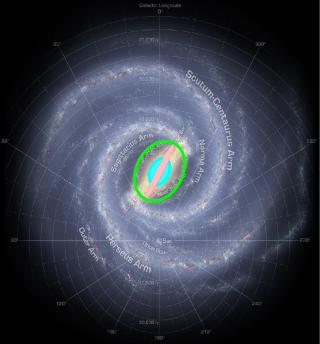
Vía Láctea y galaxias cercanas
El objetivo general del proyecto es el estudio de la morfología, poblaciones estelares, cinemática y dinámica (incluyendo formación y evolución) de la Vía Láctea y sus galaxias satélites u otras del Grupo Local. El proyecto puede dividirse en dos líneas principales: I. Estructura de la Vía Láctea y galaxias cercanas. El estudio detallado de la
Martín
López Corredoira