
Bibcode
Libralato, Mattia; Vesperini, Enrico; Bellini, Andrea; Milone, Antonino P.; van der Marel, Roeland P.; Piotto, Giampaolo; Anderson, Jay; Aparicio, Antonio; Barbuy, Beatriz; Bedin, Luigi R.; Brown, Thomas M.; Cassisi, Santi; Nardiello, Domenico; Sarajedini, Ata; Scalco, Michele
Referencia bibliográfica
The Astrophysical Journal
Fecha de publicación:
2
2023
Revista
Número de citas
25
Número de citas referidas
24
Descripción
Our understanding of the kinematic properties of multiple stellar populations (mPOPs) in Galactic globular clusters (GCs) is still limited compared to what we know about their chemical and photometric characteristics. Such limitation arises from the lack of a comprehensive observational investigation of this topic. Here we present the first homogeneous kinematic analysis of mPOPs in 56 GCs based on high-precision proper motions computed with Hubble Space Telescope data. We focused on red-giant-branch stars, for which the mPOP tagging is clearer, and measured the velocity dispersion of stars belonging to first (1G) and second generations (2G). We find that 1G stars are generally kinematically isotropic even at the half-light radius, whereas 2G stars are isotropic at the center and become radially anisotropic before the half-light radius. The radial anisotropy is induced by a lower tangential velocity dispersion of 2G stars with respect to the 1G population, while the radial component of the motion is comparable. We also show possible evidence that the kinematic properties of mPOPs are affected by the Galactic tidal field, corroborating previous observational and theoretical results suggesting a relation between the strength of the external tidal field and some properties of mPOPs. Although limited to the GCs' central regions, our analysis leads to new insights into the mPOP phenomenon, and provides the motivation for future observational studies of the internal kinematics of mPOPs.
Proyectos relacionados
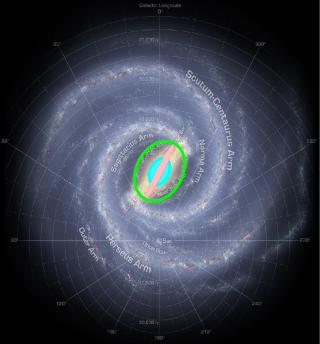
Vía Láctea y galaxias cercanas
El objetivo general del proyecto es el estudio de la morfología, poblaciones estelares, cinemática y dinámica (incluyendo formación y evolución) de la Vía Láctea y sus galaxias satélites u otras del Grupo Local. El proyecto puede dividirse en dos líneas principales: I. Estructura de la Vía Láctea y galaxias cercanas. El estudio detallado de la
Martín
López Corredoira