
Bibcode
López-Corredoira, M.; Betancort-Rijo, J. E.
Referencia bibliográfica
The Astrophysical Journal
Fecha de publicación:
3
2021
Revista
Número de citas
7
Número de citas referidas
6
Descripción
Astronomers derive MOdified Newtonian Dynamics (MOND) rotation curves using the simple algebraic rule of calculating the acceleration as equal to the Newtonian acceleration (a) divided by some factor μ(a). However, there are velocity differences between this simple rule and the calculation derived from more sophisticated MOND versions such as AQUAL or QMOND, created to expand MOND heuristic law and preserve the conservation of momentum, angular momentum, and energy, and follow the weak equivalence principle. Here we provide recipes based on Milgrom's proposal to calculate semianalytically (without numerical simulations) MOND rotation curves for any density distribution based on AQUAL, applying it to different models of thin disks. The application of this formalism is equivalent to the creation of a fictitious phantom mass whose field may be used in a Newtonian way to calculate iteratively the MOND accelerations. In most cases, the differences between the application of the simple algebraic rule and the AQUAL-MOND calculations are small, ≲5%. However, the error of the algebraic solution is larger than 5% when more than half of the mass is in the MONDian regime (where Newtonian and MOND rotation speeds differ by more than 10%), reaching in some cases >70% discrepancy, such as in Maclaurin disks, representative of galaxies for which the rotational velocity rises to the edge of the disk as is seen in irregular galaxies. The slope of the rotation speed in the dependence with the radius or the vertical distance of the plane is also significantly changed.
Proyectos relacionados
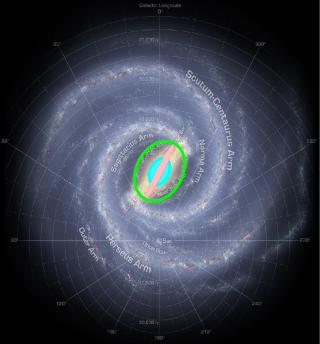
Vía Láctea y galaxias cercanas
El objetivo general del proyecto es el estudio de la morfología, poblaciones estelares, cinemática y dinámica (incluyendo formación y evolución) de la Vía Láctea y sus galaxias satélites u otras del Grupo Local. El proyecto puede dividirse en dos líneas principales: I. Estructura de la Vía Láctea y galaxias cercanas. El estudio detallado de la
Martín
López Corredoira
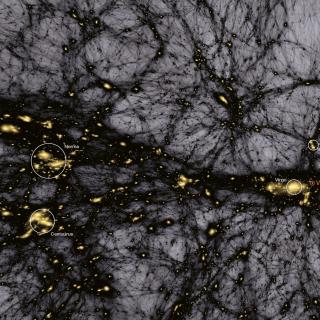
Cosmología con Trazadores de la Estructura a Gran Escala del Universo
El Fondo Cósmico de Microondas (FCM) contiene la información estadística de las semillas primigenias que han dado lugar a la formación de todas las estructuras en el Universo. Su contrapartida natural en el Universo local es la distribución de las galaxias que surgen como resultado del crecimiento gravitatorio de aquellas fluctuaciones de densidad
Francisco Shu
Kitaura Joyanes