
Bibcode
Liu, Zhaoran; Kodama, Tadayuki; Lemaux, Brian C.; Kubo, Mariko; Pérez-Martínez, Jose Manuel; Koyama, Yusei; Tanaka, Ichi; Daikuhara, Kazuki; Gal, Roy R.; Hung, Denise; Konishi, Masahiro; Kushibiki, Kosuke; Laishram, Ronaldo; Lubin, Lori M.; Motohara, Kentaro; Takahashi, Hidenori
Referencia bibliográfica
The Astrophysical Journal
Fecha de publicación:
12
2025
Revista
Número de citas
2
Número de citas referidas
2
Descripción
We present results from a dual narrowband imaging survey targeting the CL1604 supercluster at z = 0.9 using the Subaru Telescope. By combining the NB921 filter on Hyper Suprime-Cam and the NB1244 filter on SWIMS, we can detect redshifted Hα and Hβ emission lines from the supercluster. This unique technique allows us to measure both star formation rates and dust extinction for a sample of 94 emission-line galaxies across the supercluster. We find that dust extinction, estimated from the Balmer decrement (Hα/Hβ ratio), increases with stellar mass in star-forming galaxies, whereas relatively quiescent systems exhibit comparatively low extinction. Among galaxies with intermediate masses (108.5 < M* < 1010.5 M⊙), the dust-corrected Hα-based star formation rates align with the main sequence at this epoch. More massive galaxies, however, deviate from this relation, exhibit redder colors, and reside predominantly in higher-density environments. Although stellar mass, star formation rate, and galaxy color are clearly influenced by environment, we detect no strong, systematic environmental dependence of dust extinction for the whole sample. However, a trend of increasing dust extinction toward denser regions becomes evident only after excluding quiescent galaxies, as the massive quiescent populations in cluster cores contain little dust and thereby mask this relationship.
Proyectos relacionados
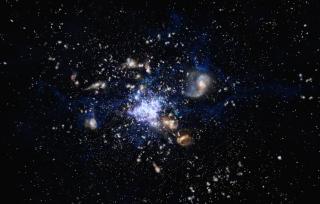
Gas Molecular y Polvo en Galacias através del Tiempo Cósmico
Dos cuestiones fundamentales en la Astrofísica son la conversión de gas molecuar en estrellas y cómo este proceso físico depende del entorno en todas las escalas, desde sistemas planetarios, cúmulos estelares, galaxias hasta cúmulos de galaxias. El objectivo principal de este proyecto es el de estudiar la formación y evolución de galaxias a partir
Helmut
Dannerbauer