
Bibcode
Marino, A. F.; Milone, A. P.; Sneden, C.; Bergemann, M.; Kraft, R. P.; Wallerstein, G.; Cassisi, S.; Aparicio, A.; Asplund, M.; Bedin, R. L.; Hilker, M.; Lind, K.; Momany, Y.; Piotto, G.; Roederer, I. U.; Stetson, P. B.; Zoccali, M.
Referencia bibliográfica
Astronomy and Astrophysics, Volume 541, id.A15
Fecha de publicación:
5
2012
Revista
Número de citas
83
Número de citas referidas
68
Descripción
We present an abundance analysis of 101 subgiant branch (SGB) stars in
the globular cluster M 22. Using low-resolution FLAMES/GIRAFFE spectra
we have determined abundances of the neutron-capture strontium and
barium and the light element carbon. With these data we explore
relationships between the observed SGB photometric split in this cluster
and two stellar groups characterized by different contents of iron, slow
neutron-capture process (s-process) elements, and the α element
calcium, which we previously discovered in M 22's red-giant stars. We
show that the SGB stars correlate in chemical composition and the
color-magnitude diagram position. The stars with higher metallicity and
relative s-process abundances define a fainter SGB, while stars with
lower metallicity and s-process content reside on a relatively brighter
SGB. This result has implications for the relative ages of the two
stellar groups of M 22. In particular, it is inconsistent with a broad
spread in ages of the two SGBs. By accounting for the chemical content
of the two stellar groups, isochrone fitting of the double SGB suggests
that their agesare not different by more than ~300 Myr.
Based on data collected at the European Southern Observatory with the
FLAMES/GIRAFFE spectrograph under the program 085.D-0698A.Tables 2 and 3
are available in electronic form at http://www.aanda.org
Proyectos relacionados
Vía Láctea y galaxias cercanas
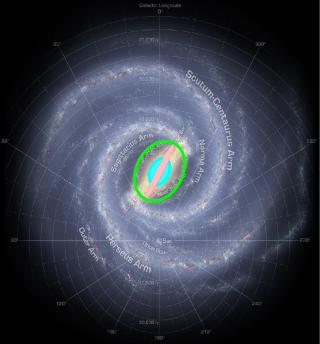
El objetivo general del proyecto es el estudio de la morfología, poblaciones estelares, cinemática y dinámica (incluyendo formación y evolución) de la Vía Láctea y sus galaxias satélites u otras del Grupo Local. El proyecto puede dividirse en dos líneas principales: I. Estructura de la Vía Láctea y galaxias cercanas. El estudio detallado de la
Martín
López Corredoira