
Bibcode
Mandushev, Georgi; Quinn, Samuel N.; Buchhave, Lars A.; Dunham, Edward W.; Rabus, M.; Oetiker, Brian; Latham, David W.; Charbonneau, David; Brown, Timothy M.; Belmonte, J. A.; O'Donovan, Francis T.
Referencia bibliográfica
The Astrophysical Journal, Volume 741, Issue 2, article id. 114 (2011).
Fecha de publicación:
11
2011
Revista
Número de citas
22
Número de citas referidas
19
Descripción
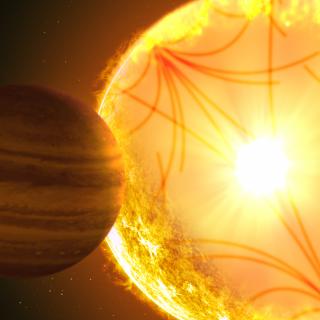
We report the discovery of TrES-5, a massive hot Jupiter that transits
the star GSC 03949-00967 every 1.48 days. From spectroscopy of the star
we estimate a stellar effective temperature of T eff = 5171
± 36 K, and from high-precision B, R, and I photometry of the
transit we constrain the ratio of the semimajor axis a and the stellar
radius R sstarf to be a/R sstarf = 6.07 ±
0.14. We compare these values to model stellar isochrones to obtain a
stellar mass of M sstarf = 0.893 ± 0.024 M
&sun;. Based on this estimate and the photometric time
series, we constrain the stellar radius to be R sstarf =
0.866 ± 0.013 R &sun; and the planet radius to be R
p = 1.209 ± 0.021 R J. We model our
radial-velocity data assuming a circular orbit and find a planetary mass
of 1.778 ± 0.063 M J. Our radial-velocity observations
rule out line-bisector variations that would indicate a specious
detection resulting from a blend of an eclipsing binary system. TrES-5
orbits one of the faintest stars with transiting planets found to date
from the ground and demonstrates that precise photometry and followup
spectroscopy are possible, albeit challenging, even for such faint
stars.
Proyectos relacionados
Sismología Solar y Estelar y Búsqueda de Exoplanetas
Los objetivos principales de este proyecto son: 1) estudiar la estructura y la dinámica del interior solar, 2) ampliar este estudio a otros tipos de estrellas y 3) buqueda de planetas extrasolares utilizando métodos fotométricos y su caracterización con información complementaria (espectrometría). Para alcanzar el primer objetivo, utilizamos la
Savita
Mathur