
Bibcode
Šubjak, Ján; Gandolfi, Davide; Goffo, Elisa; Rapetti, David; Jankowski, Dawid; Mizuki, Toshiyuki; Dai, Fei; Serrano, Luisa M.; Wilson, Thomas G.; Goździewski, Krzysztof; Nowak, Grzegorz; Jenkins, Jon M.; Twicken, Joseph D.; Winn, Joshua N.; Bieryla, Allyson; Ciardi, David R.; Cochran, William D.; Collins, Karen A.; Deeg, Hans J.; García, Rafael A.; Guenther, Eike W.; Hatzes, Artie P.; Kabáth, Petr; Korth, Judith; Latham, David W.; Livingston, John H.; Lund, Michael B.; Mathur, Savita; Narita, Norio; Orell-Miquel, Jaume; Pallé, Enric; Persson, Carina M.; Redfield, Seth; Schwarz, Richard P.; Watanabe, David; Ziegler, Carl
Referencia bibliográfica
Astronomy and Astrophysics
Fecha de publicación:
1
2025
Revista
Número de citas
5
Número de citas referidas
4
Descripción
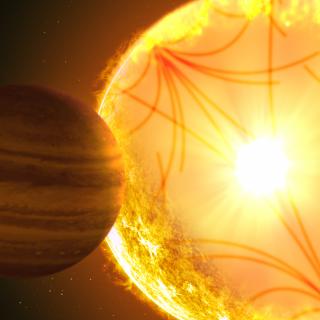
We report on the discovery and spectroscopic confirmation of TOI-2458 b, a transiting mini-Neptune around an F-type star leaving the main-sequence with a mass of M★ = 1.05 ± 0.03 M⊙, a radius of R★ = 1.31 ± 0.03 R⊙, an effective temperature of Teff = 6005 ± 50 K, and a metallicity of ‑0.10 ± 0.05 dex. By combining TESS photometry with high-resolution spectra acquired with the HARPS spectrograph, we found that the transiting planet has an orbital period of ‑3.74 days, a mass of Mp = 13.31 ± 0.99 M⊕ and a radius of Rp = 2.83 ± 0.20 R⊕. The host star TOI-2458 shows a short activity cycle of ~54 days revealed in the HARPS S-index and Ha times series. We took the opportunity to investigate other F stars showing activity cycle periods comparable to that of TOI-2458 and found that they have shorter rotation periods than would be expected based on the gyrochronology predictions. In addition, we determined TOI-2458's stellar inclination angle to be i* = 10.6‑10.6+13.3 degrees. We discuss that both phenomena (fast stellar rotation and planet orbit inclination) could be explained by in situ formation of a hot Jupiter interior to TOI-2458 b. It is plausible that this hot Jupiter was recently engulfed by the star. Analysis of HARPS spectra has identified the presence of another planet with a period of P = 16.55 ± 0.06 days and a minimum mass of Mp sin i = 10.22 ± 1.90 M⊕. Using dynamical stability analysis, we constrained the mass of this planet to the range Mc ≃ (10, 25) M⊕.
Proyectos relacionados
Sismología Solar y Estelar y Búsqueda de Exoplanetas
Los objetivos principales de este proyecto son: 1) estudiar la estructura y la dinámica del interior solar, 2) ampliar este estudio a otros tipos de estrellas y 3) buqueda de planetas extrasolares utilizando métodos fotométricos y su caracterización con información complementaria (espectrometría). Para alcanzar el primer objetivo, utilizamos la
Savita
Mathur

Exoplanetas y Astrobiología
La búsqueda de vida en el Universo se ha visto impulsada por los recientes descubrimientos de planetas alrededor de otras estrellas (los llamados exoplanetas), convirtiéndose en uno de los campos más activos dentro de la Astrofísica moderna. En los últimos años los descubrimientos cada vez más numerosos de nuevos exoplanetas y los últimos avances
Enric
Pallé Bago