
Bibcode
Kabáth, Petr; Chaturvedi, Priyanka; MacQueen, Phillip J.; Skarka, Marek; Šubjak, Ján; Esposito, Massimilliano; Cochran, William D.; Bellomo, Salvatore E.; Karjalainen, Raine; Guenther, Eike W.; Endl, Michael; Csizmadia, Szilárd; Karjalainen, Marie; Hatzes, Artie; Žák, Jiří; Gandolfi, Davide; Boffin, Henri M. J.; Vines, Jose I.; Livingston, John H.; García, Rafael A.; Mathur, Savita; González-Cuesta, Lucía; Blažek, Martin; Caldwell, Douglas A.; Colón, Knicole D.; Deeg, Hans; Erikson, Anders; van Eylen, Vincent; Fong, William; Fridlund, Malcolm; Fukui, Akihiko; Fűrész, Gábor; Goeke, Robert F.; Goffo, Elisa; Howell, Steve; Jenkins, Jon M.; Klagyivik, Peter; Korth, Judith; Latham, David W.; Luque, Rafael; Moldovan, Dan; Murgas, Felipe; Narita, Norio; Orell-Miquel, Jaume; Palle, Enric; Parviainen, Hannu; Persson, Carina M.; Reed, Phillip A.; Redfield, Seth; Ricker, George R.; Seager, Sara; Serrano, Luisa Maria; Shporer, Avi; Smith, Alexis M. S.; Watanabe, Noriharu; Winn, Joshua N.; Kesprint Team
Referencia bibliográfica
Monthly Notices of the Royal Astronomical Society
Fecha de publicación:
7
2022
Número de citas
24
Número de citas referidas
23
Descripción
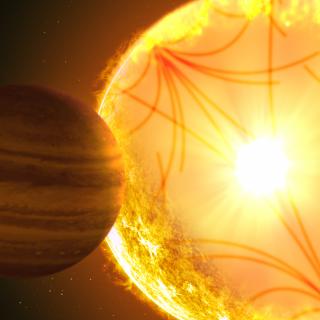
We present the confirmation and characterization of three hot Jupiters, TOI-1181b, TOI-1516b, and TOI-2046b, discovered by the TESS space mission. The reported hot Jupiters have orbital periods between 1.4 and 2.05 d. The masses of the three planets are 1.18 ± 0.14 MJ, 3.16 ± 0.12 MJ, and 2.30 ± 0.28 MJ, for TOI-1181b, TOI-1516b, and TOI-2046b, respectively. The stellar host of TOI-1181b is a F9IV star, whereas TOI-1516b and TOI-2046b orbit F main sequence host stars. The ages of the first two systems are in the range of 2-5 Gyrs. However, TOI-2046 is among the few youngest known planetary systems hosting a hot Jupiter, with an age estimate of 100-400 Myrs. The main instruments used for the radial velocity follow-up of these three planets are located at Ondřejov, Tautenburg, and McDonald Observatory, and all three are mounted on 2-3 m aperture telescopes, demonstrating that mid-aperture telescope networks can play a substantial role in the follow-up of gas giants discovered by TESS and in the future by PLATO.
Proyectos relacionados
Sismología Solar y Estelar y Búsqueda de Exoplanetas
Los objetivos principales de este proyecto son: 1) estudiar la estructura y la dinámica del interior solar, 2) ampliar este estudio a otros tipos de estrellas y 3) buqueda de planetas extrasolares utilizando métodos fotométricos y su caracterización con información complementaria (espectrometría). Para alcanzar el primer objetivo, utilizamos la
Savita
Mathur

Exoplanetas y Astrobiología
La búsqueda de vida en el Universo se ha visto impulsada por los recientes descubrimientos de planetas alrededor de otras estrellas (los llamados exoplanetas), convirtiéndose en uno de los campos más activos dentro de la Astrofísica moderna. En los últimos años los descubrimientos cada vez más numerosos de nuevos exoplanetas y los últimos avances
Enric
Pallé Bago