
Bibcode
Abe, K.; Abe, S.; Abhir, J.; Abhishek, A.; Acero, F.; Acharyya, A.; Adam, R.; Aguasca-Cabot, A.; Agudo, I.; Aguirre-Santaella, A.; Alfaro, J.; Alfaro, R.; Alispach, C.; Batista, R. Alves; Amans, J.-P.; Amato, E.; Ambrosi, G.; Ambrosino, D.; Ambrosino, F.; Angel, L.; Antonelli, L. A.; Aramo, C.; Arcaro, C.; Asano, K.; Ascasibar, Y.; Stuani, L. Augusto; Backes, M.; Balazs, C.; Balbo, M.; Baquero Larriva, A.; Barbosa Martins, V.; Barrio, J. A.; Barrios-Jiménez, L.; Bartolini, C.; Batista, P. I.; Batković, I.; Batzofin, R.; Becerra González, J.; Beck, G.; Becker Tjus, J.; Benbow, W.; Berge, D.; Bernardini, E.; Bernete, J.; Berti, A.; Bertucci, B.; Beshley, V.; Bhattacharjee, P.; Bhattacharyya, S.; Bigongiari, C.; Biland, A.; Bissaldi, E.; Blanch, O.; Blazek, J.; Bonnoli, G.; Bonollo, A.; Bosnjak, Z.; Bottacini, E.; Böttcher, M.; Bringmann, T.; Bronzini, E.; Brose, R.; Brunelli, G.; Buces Sáez, J.; Bunse, M.; Burmistrov, L.; Burton, M.; Calisse, P. G.; Campoy-Ordaz, A.; Cantlay, B. K.; Capasso, G.; Caproni, A.; Capuzzo-Dolcetta, R.; Caraveo, P.; Caroff, S.; Carosi, R.; Carquin, E.; Carrasco, M.-S.; Cascone, E.; Castignani, G.; Castro-Tirado, A. J.; Cerasole, D.; Cerruti, M.; Cortínez, A. Cerviño; Chadwick, P. M.; Chai, Y.; Chaty, S.; Chen, A. W.; Chen, Y.; Chernyakova, M.; Chiavassa, A.; Chon, G.; Chudoba, J.; Cicciari, G. M.; Cifuentes, A.; Coimbra Araujo, C. H.; Colapietro, M.; Conforti, V.; Contreras, J. L.; Cornejo, B. et al.
Referencia bibliográfica
Monthly Notices of the Royal Astronomical Society
Fecha de publicación:
12
2025
Número de citas
5
Número de citas referidas
5
Descripción
The dwarf spheroidal galaxies (dSphs) orbiting the Milky Way are widely regarded as systems supported by velocity dispersion against self-gravity, and as prime targets for the search for indirect dark matter (DM) signatures in the GeV-to-TeV $\gamma$-ray range owing to their lack of astrophysical $\gamma$-ray background. We present forecasts of the sensitivity of the forthcoming Cherenkov Telescope Array Observatory (CTAO) to annihilating or decaying DM signals in these targets. An original selection of candidates is performed from the current catalogue of known objects, including both classical and ultrafaint dSphs. For each, the expected DM content is derived using the most comprehensive photometric and spectroscopic data available, within a consistent framework of analysis. This approach enables the derivation of novel astrophysical factor profiles for indirect DM searches, which are compared with results from the literature. From an initial sample of 64 dSphs, eight promising targets are identified ─ Draco I, Coma Berenices, Ursa Major II, Ursa Minor, and Willman 1 in the North, Reticulum II, Sculptor, and Sagittarius II in the South ─ for which different DM density models yield consistent expectations, leading to robust predictions. CTAO is expected to provide the strongest limits above $\sim$10 TeV, reaching velocity-averaged annihilation cross sections of $\sim 5\times 10^{-25}$ cm$^3$ s$^{-1}$ and decay lifetimes up to $\sim 10^{26}$ s for combined limits. The dominant uncertainties arise from the imprecise determination of the DM content, particularly for ultrafaint dSphs. Observation strategies are proposed that optimize either deep exposures of the best candidates or diversified target selections.
Proyectos relacionados
Astrofísica de Partículas
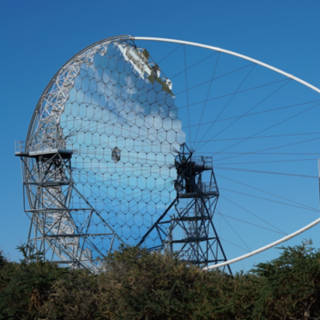
El Grupo de Astrofísica de Partículas del IAC participa activamente en tres grandes colaboraciones internacionales de astrofísica de muy altas energías: AMS-02 (Alpha Magnetic Spectrometer), los telescopios de radiación Cherenkov MAGIC I y II y el Cherenkov Telescope Array Observatory ( CTAO). Además, participamos en el ASTRI mini-array, el
Mónica Luisa
Vázquez Acosta