
Tomoki Morokuma; Malte Schramm; Toshihiro Kawaguchi; Josefa Becerra González; Jose Antonio Acosta-Pulido; Nieves Castro-Rodríguez; Kana Morokuma-Matsui; Shintaro Koshida; Junko Furusawa; Hisanori Furusawa; Tsuyoshi Terai; Fumi Yoshida; Kotaro Niinuma; Yoshiki Toba
Referencia bibliográfica
Publications of the Astronomical Society of Japan
Fecha de publicación:
11
2025
Número de citas referidas
0
Descripción
We present the discovery of a large gradual apparent fading event in optical and near-infrared wavelengths in a quasar at by a factor of (in optical) over a period of ∼20 yr in the observed frame. This pronounced fading trend in brightness was first identified by comparing the magnitudes measured in the Subaru/Hyper Suprime-Cam (HSC) images with those in the Sloan Digital Sky Survey (SDSS) images for quasars spectroscopically identified by SDSS. We performed follow-up observations, including optical imaging and spectroscopy as well as near-infrared imaging, with >4 m-class telescopes such as Subaru, GTC, Keck, and SOAR telescopes. We combine these new data with the archival data to examine the variability behavior over ∼20 yr in detail and even the longer-term trend of the variability over ∼70 yr in the observed frame. We find that (i) the active galactic nucleus (AGN) component likely faded by a factor of ∼50 from the early 2000s to 2023 and (ii) the observed brightness decline is best explained by a substantial decrease in accretion rate rather than time-varying line-of-sight dust obscuration. These findings are derived from multi-component (time-varying AGN + constant galaxy) spectral energy distribution fitting over multi-epochs, which is well consistent with the optical spectra. The Eddington ratio decreases by a factor of ∼50, from ∼0.4 to ∼0.008, if we use the black hole mass measured with the SDSS spectrum, which could be highly uncertain because of the very large variability. The total brightness is dominated by the host galaxy in the rest-frame optical wavelength rather than the AGN as of 2023.
Proyectos relacionados
Astrofísica de Partículas
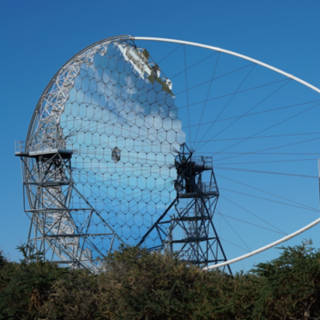
El Grupo de Astrofísica de Partículas del IAC participa activamente en tres grandes colaboraciones internacionales de astrofísica de muy altas energías: AMS-02 (Alpha Magnetic Spectrometer), los telescopios de radiación Cherenkov MAGIC I y II y el Cherenkov Telescope Array Observatory ( CTAO). Además, participamos en el ASTRI mini-array, el
Mónica Luisa
Vázquez Acosta