
Bibcode
Moreno-Insertis, Fernando; Hansteen, Viggo H.; Nóbrega-Siverio, Daniel
Referencia bibliográfica
The Astrophysical Journal
Fecha de publicación:
12
2025
Revista
Número de citas
3
Número de citas referidas
3
Descripción
We present a radiation-magnetohydrodynamics (RMHD) simulation of a magnetic cancellation event. The model is calculated with the Bifrost code and spans from the uppermost convection zone to the corona. The cancellation occurs between the positive polarity of an emerged magnetic bipole and a preexisting negative polarity. We try both to understand the RMHD aspects as well as to carry out comparison to observations, in part via spectral synthesis of optically thick photospheric and chromospheric lines using the RH1.5D code, and optically thin coronal ones. The reconnection between the opposite flux systems takes place at chromospheric heights without null points. Sharp V-shaped upward-moving field lines and highly warped downward-moving post-reconnection loops are created. The chromospheric reconnection is in full swing when the colliding magnetic patches are still separated by a granular cell at the photosphere. In a later phase, photospheric cancellation takes place with submergence of the closed magnetic loops linking the opposite polarities. We carry out comparisons with the observations of the photospheric magnetic flux loss rates, as well as of the horizontal magnetic field and vertical velocity at the polarity inversion line. The reconnection outflows cause intensity brightenings, jets, and different spectral features in the synthesized chromospheric spectral lines, strongly reminiscent of those found in recent observations. Coherent, twisted magnetic flux ropes are created by the flows associated with the process. Including coronal levels is crucial for proper modeling, even if no major ejection or brightening is produced in the corona in this event.
Proyectos relacionados
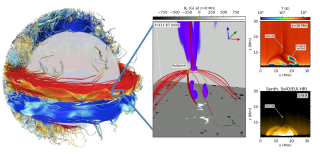
El proyecto Whole Sun: desentrañando los complejos mecanismos físicos detrás de nuestra estrella eruptiva y sus gemelos
El Sol es una estrella activa magnéticamente cuyas erupciones violentas pueden impactar y deformar la magnetosfera terrestre y causar perturbaciones importantes en instalaciones tecnológicas en tierra y en órbita. The Whole Sun tiene como objetivo central abordar, de forma coherente y por primera vez, cuestiones actuales clave en Física Solar
Fernando
Moreno Insertis

Simulación Numérica de Procesos Astrofísicos
La simulación numérica mediante códigos complejos de ordenador es una herramienta fundamental en la investigación física y en la técnica desde hace décadas. El crecimiento vertiginoso de las capacidades informáticas junto con el avance notable de la matemática numérica ha hecho accesible a los centros de investigación de tamaño medio