
Bibcode
Zarattini, Stefano; Biviano, Andrea; Bartalucci, Iacopo; Aguerri, J. Alfonso L.; Haines, Christopher P.; Girardi, Marisa
Referencia bibliográfica
Astronomy and Astrophysics
Fecha de publicación:
12
2025
Revista
Número de citas
0
Número de citas referidas
0
Descripción
Context. Fossil groups (FGs) are groups or clusters of galaxies with a single, massive, central galaxy dominating their luminosity distribution, and with a clear lack of L∗ galaxies. The physical reason for the large magnitude gap (∆m12) in these systems is still a matter for investigation. It could originate in an early formation of FGs, followed by passive evolution in which all L∗ galaxies merged with the central one, and/or it could be related to the fact that galaxies accreting on the FGs move on very radial orbits, reach small pericentric radii, and are merged on shorter timescales than regular cluster galaxies. The latter properties could be linked with the peculiar position of FGs within the cosmic web. Aims. To shed light on the origin of FGs, we determine the velocity anisotropy profile β(r) of the fossil cluster A267, which is related to the orbital distribution of cluster galaxies. This is the first individual FG for which the orbital distribution of its galaxies is determined. We aim to confirm previous findings based on stack samples that indicate that FGs, on average, host galaxies on more radial orbits than normal clusters. Methods. We started with a sample of 2315 redshifts for galaxies in the field of A267 and we determined the membership for 329 of them. Of these, 174 are located within the virial radius of the cluster, and we used them as tracers of the gravitational potential of the cluster to solve the Jeans equation for dynamical equilibrium using the MAMPOSSt algorithm. As a result, we obtained the cluster mass profile M(r) and β(r). We also estimated M(r) from the X-ray data by applying the hydrostatic equilibrium. Results. A comparison of the MAMPOSSt and X-ray-determined M(r)s allows us to estimate the cluster hydrostatic mass bias, which we find to be consistent with previous findings. The anisotropy parameter β(r) indicates tangential orbits for the galaxies near the cluster centre and increasingly radial orbits in the external regions. We checked that our results are not affected by the presence of subclusters and by the choice of the models for M(r) and β(r). Conclusions. The A267 β(r) is very similar to that previously determined for a stack of large ∆m12 systems. Our analysis therefore confirms that FGs are characterized by more radial orbits for their member galaxies than the average cluster population. We speculate that this different orbital distribution might be an important element in creating a large ∆m12.
Proyectos relacionados
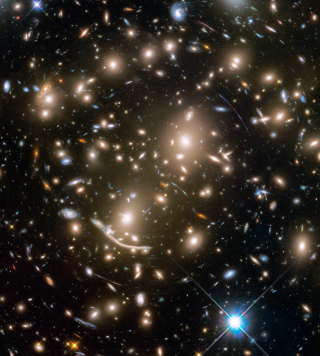
Evolución de Galaxias en Cúmulos
Las estructuras en el Universo, a todas las escalas de masa, se han formado de una forma jerárquica y principalmente producidas por fusiones de galaxias. Sin embargo, esta formación jerárquica de las galaxias está modulada por el entorno en el cual se crean y evolucionan. Mientras que las galaxias de campo presentan una evolución pasiva, los
Jairo
Méndez Abreu