
van de Ven, Glenn; Falcón-Barroso, Jesús; Lyubenova, Mariya
Referencia bibliográfica
Annual Review of Astronomy and Astrophysics
Fecha de publicación:
8
2025
Número de citas
7
Número de citas referidas
5
Descripción
In this review, we show how combining dynamical and stellar population models with integral field spectroscopic data of nearby galaxies enables uncovering their assembly history. ▪ We discuss the advantages and limitations of various dynamical modelling approaches, focusing on measuring the mass distributions of nearby galaxies, including central black holes and dark matter halos. ▪ We highlight the use of Schwarzschild's orbit-superposition method to robustly decompose galaxies into dynamically distinct components and derive their intrinsic properties. ▪ We cover the application of single stellar population models to interpret observations of unresolved stars in nearby galaxies. ▪ We outline how combining dynamical and stellar population models can reveal the fossil records of galaxy assembly, from the origin of inner galaxy structures, to the buildup of disks, to the recovery of past galaxy mergers. We discuss the advantages and limitations of various dynamical modelling approaches, focusing on measuring the mass distributions of nearby galaxies, including central black holes and dark matter halos. We highlight the use of Schwarzschild's orbit-superposition method to robustly decompose galaxies into dynamically distinct components and derive their intrinsic properties. We cover the application of single stellar population models to interpret observations of unresolved stars in nearby galaxies. We outline how combining dynamical and stellar population models can reveal the fossil records of galaxy assembly, from the origin of inner galaxy structures, to the buildup of disks, to the recovery of past galaxy mergers. We close by demonstrating how these models of nearby galaxies provide a bridge between studies of resolved stars in the local Universe and high-redshift galaxy observations. Together with direct coupling to state-of-the-art cosmological simulations, extragalactic archaeology promises key insights into galaxy formation and evolution.
Proyectos relacionados
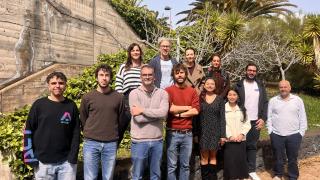
Huellas de la Formación de las Galaxias: Poblaciones estelares, Dinámica y Morfología
Bienvenida a la página web del g rupo de investigación Traces of Galaxy Formation. Somos un grupo de investigación amplio, diverso y muy activo cuyo objetivo principal es entender la formación de galaxias en el Universo de una manera lo más completa posible. Con el estudio detellado de las poblaciones estelares como bandera, estamos constantemente
Anna
Ferré Mateu