
Bibcode
Chaplin, W. J.; Bedding, T. R.; Bonanno, A.; Broomhall, A.-M.; García, R. A.; Hekker, S.; Huber, D.; Verner, G. A.; Basu, S.; Elsworth, Y.; Houdek, G.; Mathur, S.; Mosser, B.; New, R.; Stevens, I. R.; Appourchaux, T.; Karoff, C.; Metcalfe, T. S.; Molenda-Żakowicz, J.; Monteiro, M. J. P. F. G.; Thompson, M. J.; Christensen-Dalsgaard, J.; Gilliland, R. L.; Kawaler, S. D.; Kjeldsen, H.; Ballot, J.; Benomar, O.; Corsaro, E.; Campante, T. L.; Gaulme, P.; Hale, S. J.; Handberg, R.; Jarvis, E.; Régulo, C.; Roxburgh, I. W.; Salabert, D.; Stello, D.; Mullally, F.; Li, J.; Wohler, W.
Referencia bibliográfica
The Astrophysical Journal Letters, Volume 732, Issue 1, article id. L5 (2011).
Fecha de publicación:
5
2011
Número de citas
156
Número de citas referidas
132
Descripción
We use photometric observations of solar-type stars, made by the NASA
Kepler Mission, to conduct a statistical study of the impact of stellar
surface activity on the detectability of solar-like oscillations. We
find that the number of stars with detected oscillations falls
significantly with increasing levels of activity. The results present
strong evidence for the impact of magnetic activity on the properties of
near-surface convection in the stars, which appears to inhibit the
amplitudes of the stochastically excited, intrinsically damped
solar-like oscillations.
Proyectos relacionados
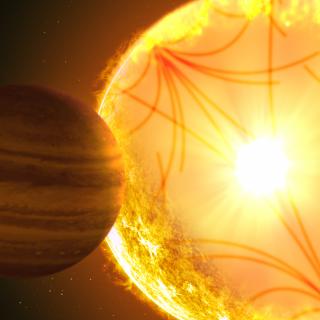
Sismología Solar y Estelar y Búsqueda de Exoplanetas
Los objetivos principales de este proyecto son: 1) estudiar la estructura y la dinámica del interior solar, 2) ampliar este estudio a otros tipos de estrellas y 3) buqueda de planetas extrasolares utilizando métodos fotométricos y su caracterización con información complementaria (espectrometría). Para alcanzar el primer objetivo, utilizamos la
Savita
Mathur