
Bibcode
Querejeta, Miguel; Meidt, Sharon E.; Cao, Yixian; Colombo, Dario; Emsellem, Eric; García-Burillo, Santiago; Klessen, Ralf S.; Koch, Eric W.; Leroy, Adam K.; Ruiz-García, Marina; Schinnerer, Eva; Smith, Rowan; Stuber, Sophia; Thorp, Mallory; Williams, Thomas G.; Boquien, Médéric; Dale, Daniel A.; Faesi, Chris; Gleis, Damian R.; Grasha, Kathryn; Hughes, Annie; Jiménez-Donaire, María J.; Kreckel, Kathryn; Liu, Daizhong; Neumann, Justus; Pan, Hsi-An; Pinna, Francesca; Razza, Alessandro; Saito, Toshiki; Sun, Jiayi; Usero, Antonio
Referencia bibliográfica
Astronomy and Astrophysics
Fecha de publicación:
9
2025
Revista
Número de citas
7
Número de citas referidas
6
Descripción
Spiral arms play a central role in disc galaxies, but their dynamical nature remains a long-standing open question. Azimuthal offsets between molecular gas and star formation are expected if gas crosses spiral arms, as predicted by quasi-stationary density wave theory. In this work, we measure offsets between CO and Hα peaks in radial bins for 24 galaxies from the PHANGS survey that display a well-delineated spiral structure. The offsets exhibit substantial scatter, implying that star formation is not exclusively initiated at a coherent spiral shock. We define offsets such that positive values mean Hα peaks lie ahead of CO peaks in the direction of galactic rotation. With this convention, 14 galaxies show mean positive CO-Hα offsets, typically of a few hundred parsecs. In four of these 14 galaxies (17% of the total), offsets become smaller with increasing radius, as expected for a single quasi-stationary spiral density wave. Ten galaxies (42%) show positive mean offsets but no clear correlation with radius, which is compatible with multiple overlapping modes. In the remaining ten galaxies (42%), we find no significantly positive offsets, which could point to transient dynamical spirals or material arms, where gas and stars co-rotate with the spiral perturbation. Across the full sample, we find mostly positive offsets between CO peaks and the gravitational potential minimum, confirming that gas often crosses the spiral perturbation. For the four galaxies with clear positive offsets and a radial trend, we derived pattern speeds in good agreement with the literature. Overall, our results suggest that even well-delineated spirals in the local Universe can arise from a variety of underlying dynamical mechanisms.
Proyectos relacionados
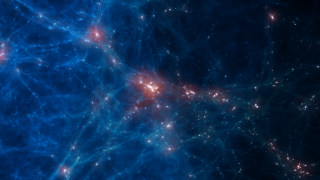
Astrofísica Numérica: Formación y Evolución de Galaxias
Entre las cuestiones fundamentales en Astronomía y Astrofísica están la formación y evolución de galaxias. Las escalas de tiempo y tamaño son tan astronómicas que su observación en galaxias individuales es imposible. Solo con el uso de simulaciones numéricas es posible entender la formación de estructuras cósmicas dentro del actual marco
Claudio
Dalla Vecchia
Huellas de la Formación de las Galaxias: Poblaciones estelares, Dinámica y Morfología
Bienvenida a la página web del g rupo de investigación Traces of Galaxy Formation. Somos un grupo de investigación amplio, diverso y muy activo cuyo objetivo principal es entender la formación de galaxias en el Universo de una manera lo más completa posible. Con el estudio detellado de las poblaciones estelares como bandera, estamos constantemente
Anna
Ferré Mateu