
Bibcode
Joshi, Reetika; Rouppe van der Voort, Luc; Aulanier, Guillaume; Danilovic, Sanja; Prasad, Avijeet; Díaz Baso, Carlos J.; Nóbrega-Siverio, Daniel; Poirier, Nicolas; Calchetti, Daniele
Referencia bibliográfica
Astronomy and Astrophysics
Fecha de publicación:
2
2026
Revista
Número de citas
1
Número de citas referidas
1
Descripción
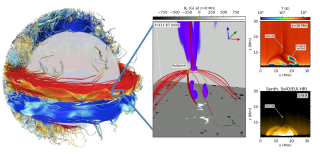
Context. The fine structures of the solar chromosphere, driven by photospheric motions, play a crucial role in the dynamics of solar magnetic fields. Many such structures have already been identified, such as fibrils, filament feet, and arch filament systems. Nevertheless, high-resolution observations show a wealth of structures whose nature remains elusive. Aims. We observed a puzzling, unprecedented chromospheric fibril singularity in the close vicinity of a blow-out solar jet and a flaring loop. We aim to understand the magnetic nature of this singularity and the cause of its activity using coordinated high-resolution, multi-wavelength observations. Methods. We aligned datasets from Solar Orbiter, SST, IRIS, and SDO. We re-projected the Solar Orbiter datasets to match the perspective of the Earth-based instruments and performed potential field extrapolations from Solar Orbiter/PHI data. We analysed the spatial and temporal evolution of the plasma structures and their link with the surface magnetic field. This led us to derive a model and scenario for the observed structures, which we explain in a general schematic representation. Results. We have discovered a new feature: a singularity in the chromospheric fibril pattern. It forms in a weak magnetic-field corridor between two flux concentrations of equal sign, at the base of a vertically inverted-Y-shaped field-line pattern. In this specific case, some activity develops along the structure: first, a flaring loop at one end, and second, a blow-out jet at the other end, where a coronal null point was present and associated with a chromospheric saddle point located on the fibril singularity. The observations suggest that both active phenomena are initiated by converging photospheric moat flows that exert pressure on this fibril singularity.
Proyectos relacionados
El proyecto Whole Sun: desentrañando los complejos mecanismos físicos detrás de nuestra estrella eruptiva y sus gemelos
El Sol es una estrella activa magnéticamente cuyas erupciones violentas pueden impactar y deformar la magnetosfera terrestre y causar perturbaciones importantes en instalaciones tecnológicas en tierra y en órbita. The Whole Sun tiene como objetivo central abordar, de forma coherente y por primera vez, cuestiones actuales clave en Física Solar
Fernando
Moreno Insertis