News

This section includes scientific and technological news from the IAC and its Observatories, as well as press releases on scientific and technological results, astronomical events, educational projects, outreach activities and institutional events.

Displaying 1 - 6 of 323
Advertised on
  •  Puertas abiertas del Observatorio del Teide 2026
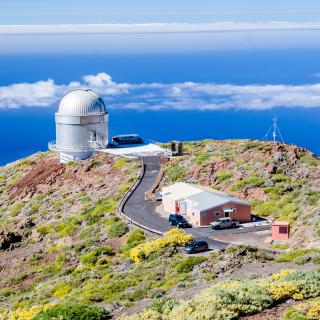
    El Instituto de Astrofísica de Canarias (IAC) invita un año más a la ciudadanía a visitar las instalaciones del Observatorio del Teide (Izaña, Tenerife) durante el fin de semana del sábado 20 y el domingo 21 de junio, coincidiendo con la semana del solsticio de verano. Esta iniciativa gratuita de divulgación científica está organizada por la propia Administración del Observatorio del Teide junto a la Unidad de Comunicación y Cultura Científica (UC3) del IAC. Para acceder a esta visita es necesario rellenar el siguiente formulario que se abre el día 1 de junio a las 10:00 horas y que se
    Advertised on
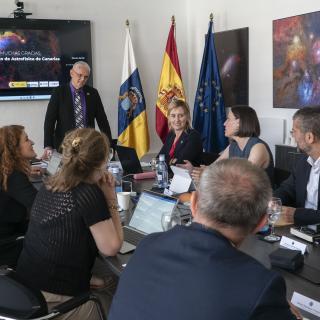
  • Roberta Zanin, responsable científica del CTAO; Valentín Martínez Pillet, director del IAC; y Juan Ramón Felipe San Antonio, vicepresidente del Cabildo de La Palma.
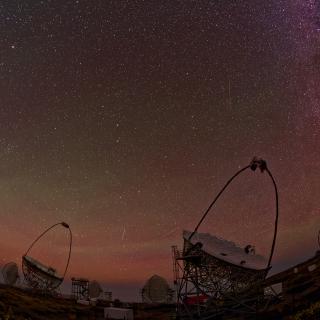
    El Cherenkov Telescope Array Observatory (CTAO) , el futuro observatorio de astronomía de rayos gamma más grande y potente del mundo, continúa su avance constante hacia su fase de operaciones iniciales. En una rueda de prensa conjunta celebrada en Santa Cruz de La Palma, Islas Canarias (España), representantes de la Organización Central del CTAO (CTAO ERIC), la Colaboración LST del CTAO , el Cabildo de La Palma y el Instituto de Astrofísica de Canarias (IAC) se reunieron para destacar el avance del proyecto hacia una ciencia pionera. Este progreso está marcado por la próxima inauguración de
    Advertised on
  • Galaxia M104
    El Two-meter Twin Telescope (TTT) ha alcanzado la primera luz de su cuarto telescopio, el segundo de dos metros de apertura, con una imagen de la galaxia espiral M104, conocida como la Galaxia del Sombrero y situada a unos 31 millones de años luz en la constelación de Virgo. Con este hito la infraestructura de cuatro telescopios se consolida como el mayor sistema óptico del Observatorio del Teide. El nuevo instrumento ha superado su validación astrométrica mediante la medición científica de la posición de asteroides cercanos a la Tierra. Su precisión ha sido confirmada por el Minor Planet
    Advertised on
  • Milky Way-like galaxies from the BEARD project
    The international BEARD project, led from the Instituto de Astrofísica de Canarias (IAC) and the University of La Laguna (ULL), has used data from several telescopes at the Roque de los Muchachos Observatory, and computer simulations to explain how galaxies similar to the Milky Way have managed to survive the most violent stages of the history of the Universe. The present model for the evolution of the universe predicts an epoch dominated by important mergers of galaxies some ten thousand million years ago. “It’s a case of violent interactions, in which it is foreseeable that weak structures
    Advertised on
  • A comparison between the bright and faint phases of a supermassive black hole
    An international team of astronomers, including researchers from the Instituto de Astrofísica de Canarias (IAC) and the Gran Telescopio Canarias (GTC), has observed a dramatic change in a supermassive black hole. Located about 10 billion light-years away, the object dimmed to roughly one-twentieth of its former brightness in just two decades — an extraordinarily short interval on cosmic timescales. The discovery was made within a collaborative observing framework linking Japan’s Subaru Telescope with the GTC in Spain’s Canary Islands at the Roque de los Muchachos Observatory, in La Palma
    Advertised on
  • Laser launched from the Teide Observatory.
    The Instituto de Astrofísica de Canarias is designing and developing, as ordered by the Spanish company Thales Alenia Space , the adaptive optics which will be a parto f the ground station for the GARBO project, the first Spanish geostationary system for distributing quantum keys by satellite. This is a decisive step in the field of secure quantum communication on a large scale, and will strengthn the position of Spain, and of Europe at the Forefront of this technology. Within the framework of the project the IAC will lead the development of the adaptive optics systems, and will participate
    Advertised on