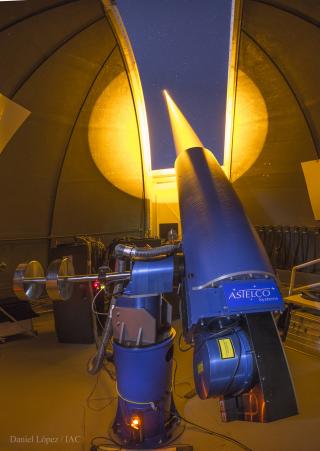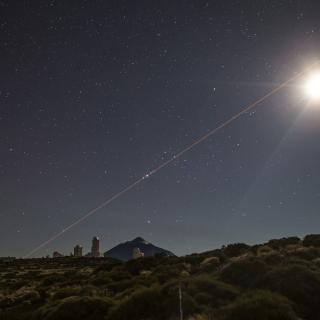

A Google Earth image of the Roque de los Muchachos Observatory on La Palma, showing the layout of the two LPQI-Pathfinder optical telescopes. The orange line indicates the 550-metre distance between the Telescopio Nazionale Galileo (TNG) and the Nordic Optical Telescope (NOT), which are connected via the fibre-optic network of the Canary Islands Institute of Astrophysics and RedIRIS. The dotted lines indicate the distances to other telescopes which, in future phases, could eventually be added to the project.
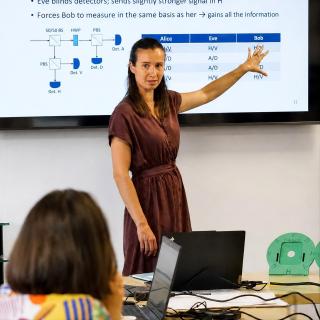
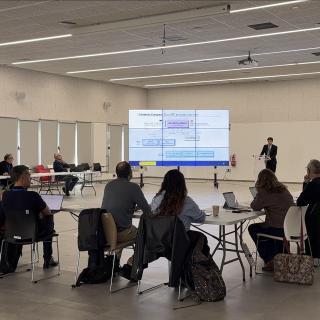
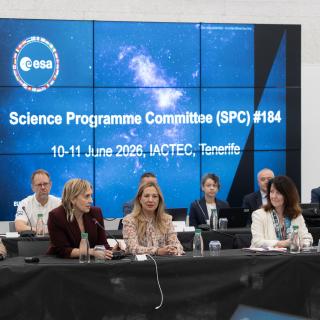
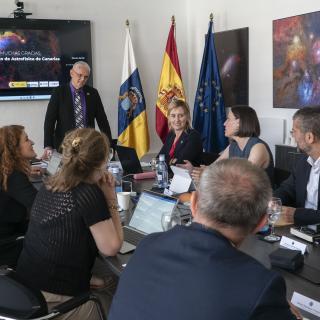
A meeting brought together scientists, technologists and institutional representatives to present the latest developments in the La Palma Quantum Interferometer (LPQI) project, outline its next steps and analyse the potential of quantum technologies to drive science, innovation and sustainable development on La Palma.
As part of the La Palma Quantum Interferometer (LPQI) project, scientists, technologists and institutional representatives met from 8 to 10 September at IACTEC in La Laguna (Tenerife) to hold the LPQI Workshop 2026, an event at which the latest advances were presented and the next phases were defined for an initiative that aims to connect several optical telescopes at the Roque de los Muchachos Observatory (ORM) using quantum technologies. The project involves a collaboration between institutions in Spain, Italy, Taiwan and the Nordic countries, and currently includes two telescopes from the ORM.
The initiative will use interferometry techniques to combine the visible light captured by different telescopes and make them function as a single instrument, as well as SPAD sensors – microchips capable of detecting individual photons and recording their arrival with a temporal resolution of picoseconds. Spanish teams at the LPQI are designing these sensors and their electronics, and characterising them for astronomical applications. By comparing the arrival of photons at telescopes separated by great distances, the system will be able to distinguish much finer details than each telescope could on its own, with an angular resolution — the ability to distinguish very fine details — of tens of microseconds of arc, up to a thousand times better than that of the Hubble Space Telescope.
The concentration of large telescopes at the ORM and the quality of its skies make La Palma an ideal location for developing this technology. Its scientific objectives include studying black holes and other extreme phenomena, exploring new ways to detect Earth-sized exoplanets, determining the Hubble constant – which measures the rate of expansion of the universe – using nearby supernovae, and measuring the diameters and atmospheres of stars.
“The LPQI represents a strategic commitment to developing technologies at the Roque de los Muchachos Observatory that can transform the way we observe the universe. For the IAC, this project reinforces the Observatory’s role as a leading centre for astronomical innovation and opens up new opportunities for scientific and technological collaboration, with the potential to generate knowledge and capabilities that can also contribute to the development of La Palma,” said Valentín Martínez Pillet, director of the Instituto de Astrofísica de Canarias (IAC).
The first phase, known as LPQI Pathfinder, will link the Nordic Optical Telescope (NOT) and the Telescopio Nazionale Galileo (TNG), which are separated by around 550 metres, and will enable the LPQI technology to be validated. The roadmap anticipates the first scientific results in the spring of 2028, with an angular resolution of 160 microseconds of arc. “The Pathfinder will enable us to measure the angular size of the brightest stars and will be the first step towards a wider network of telescopes equipped with spectrographs,” explained Francisco Prada, principal investigator of the LPQI project, an affiliated researcher at the IAC and a research professor at the Instituto de Astrofísica de Andalucía (IAA-CSIC).
Connecting science, technology and the region
The programme brought together the scientific, technological and regional dimensions of the LPQI. The institutional session featured Valentín Martínez Pillet, director of the IAC; Javier Franco, director-general of the Canary Islands Agency for Research, Innovation and the Information Society; and Héctor Izquierdo, special commissioner for the reconstruction of La Palma. The three also took part in a round-table discussion with José Joaquín Hernández, director of the Canary Islands Oceanic Platform (PLOCAN), and representatives from the Centre for Technological Development and Innovation (CDTI) and EMERGE on training, skilled employment and technology companies on the island.
The technical sessions for the LPQI Pathfinder project addressed the development of SPAD sensors, cameras, ultra-fast electronics, cooling, time synchronisation, integration into the NOT and TNG telescopes, and data analysis using artificial intelligence. The working groups planned the next phases of integration and validation.
Time synchronisation is one of the main technological challenges: via fibre-optic links, the telescopes will need to share a time reference accurate to picoseconds. A picosecond is one trillionth of a second, an interval in which light travels a mere 0.3 millimetres. The Spanish partners in the LPQI project will install and calibrate the system this autumn.
The meeting also addressed FIRNAS, the LPQI’s first spectrograph, designed for the Isaac Newton Telescope. “FIRNAS will split starlight into different bands to improve the sensitivity of measurements and facilitate the integration of the Isaac Newton Telescope into the future LPQI network,” said Arturo Manchado, FIRNAS’s principal investigator and head of the LPQI at the IAC.
Proposals were also presented to develop, within the framework of the Pathfinder project, experiments with synchronisation systems based on extremely precise quantum clocks, using techniques that employ entangled photons — particles of light whose properties remain linked. These techniques would make it possible to retrieve information about the phase of the light and reconstruct images with greater precision. “Combining these photons with starlight could enable us to access information that has hitherto been inaccessible and lay the foundations for a new generation of quantum telescope networks in the ORM,” said Luis Fernando Rodríguez, a collaborator with the LPQI, principal investigator at the Free-Space Optical Communications (FSOC) laboratory and head of the IAC’s Department of Electronics.
The capabilities developed by the LPQI can also be applied to quantum communications, marine sciences, satellites and medicine. The project also offers an opportunity to develop talent and strengthen La Palma’s innovation ecosystem.
The Special Commissioner for the Reconstruction of La Palma, Héctor Izquierdo, has set out a vision for the island in which science and technology play an increasingly significant role in the island’s economy. The establishment of permanent research centres, the development of the LPQI, research into volcanology and natural hazards, geothermal energy, ocean observation and the blue economy could, according to the proposals put forward, help to shape a genuine ‘Atlantic laboratory island’, specialising in areas of knowledge in which La Palma has unique advantages. Izquierdo also emphasised that this transformation must extend to society as a whole and to all productive sectors: “Science can contribute to a more technologically advanced and water-efficient agriculture, and to tourism with greater added value linked to astronomy, nature and knowledge.”
The meeting gave impetus to the development of the LPQI, the scope of which is summed up in its motto: “More than science. An island that discovers. A society that prospers”.
More information:
Contacts:
Francisco Prada, f.prada [at] csic.es (f[dot]prada[at]csic[dot]es)
Arturo Manchado, arturo.manchado [at] iac.es (arturo[dot]manchado[at]iac[dot]es)
Luis Fernando Rodríguez, lrr [at] iac.es (lrr[at]iac[dot]es)