Related grants:
General
This project aims at the searching, observation and analysis of massive stars in nearby galaxies to provide a solid empirical ground to understand their physical properties as a function of those key parameters that gobern their evolution (i.e. mass, spin, metallicity, mass loss, and binary interaction).
Massive stars are central objects to Astrophysics. Born with at least 8 solar masses, their evolution proceeds very fast, yielding large amounts of nuclear processed material by means of strong stellar winds (loosing up to 90% of their initial mass before facing a violent death as Supernova) and emitting intense radiation fields. Despite their scarcity, massive stars play a decisive role in many aspects of the evolution of the Cosmos (e.g. they are primary agents of the chemical and dynamical evolution of galaxies and have been proposed as key agents in the reionization of the Universe). Along their complex evolution, they are associated with the most extreme stellar objects (O-type and WR stars; blue and red supergiants; luminous blue variables; massive stellar black holes, neutron stars and magnetars; massive X- and gamma-ray binaries). They are also the origin of newly studied phenomena such as long-duration GRBs or the recently detected gravitational waves produced by a merger of two massive black holes or neutron stars. From a practical perspective, massive stars have become invaluable indicators of present-day abundances and distances in external galaxies, even beyond the Local Group. In addition, the interpretation of the light emitted by H II regions and starburst galaxies relies on our knowledge of the effect that the strong ionizing radiation emitted by these hot stellar objects produces on the surrounding interstellar medium.
This project aims at the searching, observation and analysis of massive stars in nearby galaxies to provide a solid empirical ground to understand their physical properties as a function of those key parameters that gobern their evolution (i.e. mass, spin, metallicity, mass loss, and binary interaction). In this endeavour, the project benefits from best quality observations obtained with the last generation of facilities available at the Canary and the ESO observatories, as well as other observations of interest provided from space missions such as Gaia, HST, IUE and TESS. Samples with a few to several hundreds of individual massive stars in different evolutionary stages and metallicity environments are then analyzed with the last generation of stellar atmosphere codes and optimized tools for the quantitative spectroscopic analysis of massive stars to extract as much empirical information as possible about stellar+wind parameters, surface abundances and spectroscopic variability.
The main research lines presently active in the project are:
- the observation and analysis of large samples of massive OB stars in the Milky Way;
- the exploration of the hidden population of massive stars in the Milky Way;
- the searching, observation and analysis of massive extragalactic stars, with special emphasis in those found in low metallicity galaxies;
- the development and use of model atmospheres, model atoms and numerical tools for the analysis of massive stars.
Members
Results
Highlights 2020
1. The IACOB project presents empirical evidence of the scarcity of Galactic O-type stars with masses 40-80 Msol close to the theoretical zero age main sequence. Th reason of this result could be indicating that the accretion rate of mass during the stars formation process of massive stars could be lower than traditionally considered.
2. Presented empirical evidence of the existence of multiple star forming bursts in the Cygnus OB2 massive star formation region. The way is paved for the first in-depth study of the massive star population of the Cygus-X region in the Milky Way benefiting from the WEAVE survey.
3. Studied membership and kinematical properties in a sample of 80 blue and red supergiants in the PerOB1 association by using high resolution multi-epoch spectroscopy and Gaia astrometry data. A forthcoming spectroscopic study of this sample of star will provide new empirical clues to improve our understanding of massive stars evolution.
4. The MAMSIE-IACOB collaboration presents first in-depth study of the pulsational propeties of a large sample of massive Galactic OB-type stars by means of the combined study of high-resolution spectroscopic data from HERMES, FIES and SONG and high cadence photometric data provide by the TESS mission.
5. Estimated that the binarity fraction for evolved high-mass stars (red supergiants) should be at least 0.15±0.03.
6. Identified the first strong candidate to be a super-AGB star in the Galaxy (VX Sgr).
Scientific activity
Related publications
Related conferences
-
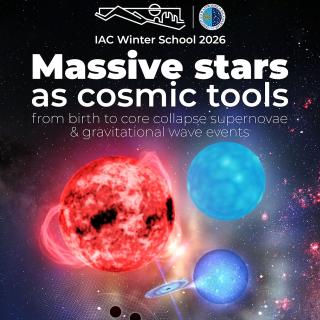 XXXVII Canary Islands Winter School of AstrophysicsThe XXXVII Canary Islands Winter School of Astrophysics, organized by the Instituto de Astrofísica de Canarias (IAC), focuses on Massive stars as cosmic tools: from birth to core collapse supernovaeC/ Álvaro Martín Díaz, 2 Parque Tecnológico de Las Mantecas CP: 38320 La Laguna Santa Cruz de TenerifeSpainDate-Upcoming