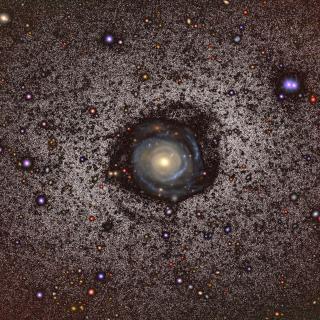

How large can a galaxy grow? This is the question behind a new study led by the Instituto de Astrofísica de Canarias (IAC), in which an international team of astronomers has measured, with unprecedented precision, the size of IC 1101, considered the largest known galaxy in the Universe. The study has been published in Astronomy & Astrophysics.
The result confirms that this cosmic giant is even larger than previously thought. The main body of IC 1101 reaches a diameter of around 1.7 million light-years, approximately 20 times the size of the Milky Way. If it were placed between our galaxy and Andromeda, its extension would almost cover the distance between them.
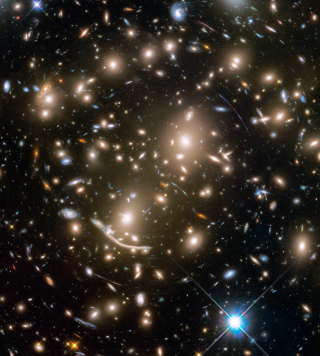
IC 1101 lies at the centre of the galaxy cluster Abell 2029, about one billion light-years from Earth. For decades, it has been known as an extraordinarily large galaxy, but its true physical size had remained unclear. Previous studies had shown that it was enormous, but they had not been able to answer a more fundamental question: where does the main body of the galaxy actually end?
“IC 1101 was already famous for being an extreme galaxy, but until now we did not have a robust measurement of its physical edge,” explains Carlos Marrero-de la Rosa, researcher at the IAC and lead author of the study. “We wanted to answer a simple but fundamental question: how large can a galaxy grow in the present-day Universe?”
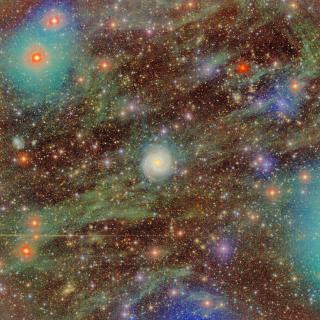
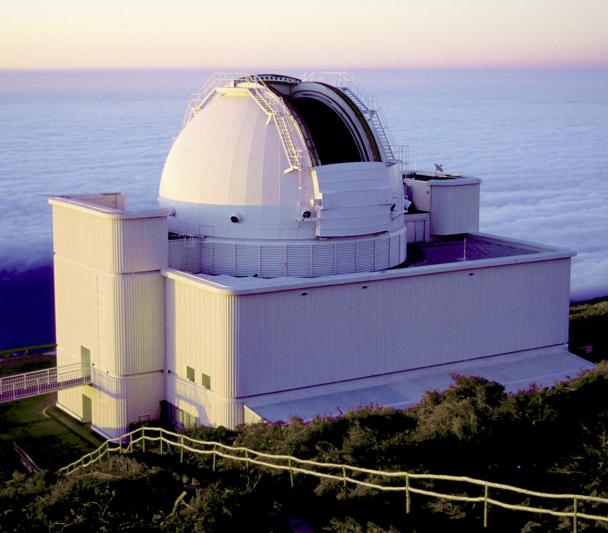
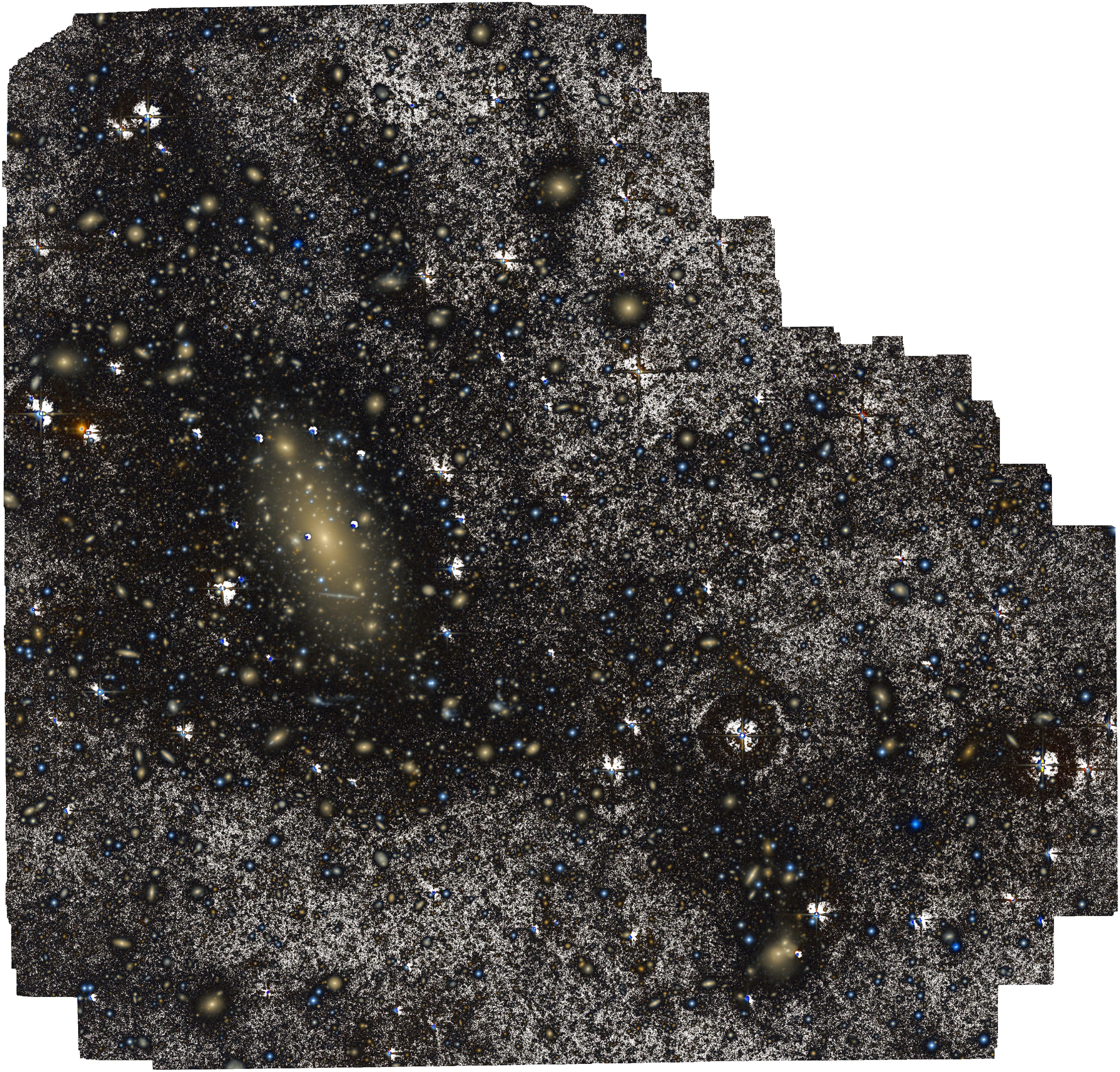
To answer this, the team used the deepest images ever obtained of IC 1101, taken with the Isaac Newton Telescope (INT), located at the Roque de los Muchachos Observatory on La Palma. These ultra-deep images made it possible to observe extremely faint regions of the galaxy, invisible in shallower images, and to reveal the structure of its outermost parts.

The analysis shows that the main body of IC 1101 extends out to a radius of around 850,000 light-years. This implies a total diameter of about 1.7 million light-years. Within this boundary, the galaxy contains around 3.4 trillion solar masses in stars, about 70 times more than the Milky Way.
A galaxy, however, does not have an edge like a solid object. Its stars become progressively more diffuse as we move away from the centre. The edge measured in this work corresponds to the point at which IC 1101 stops behaving as an organised structure and begins to blend with the diffuse light of the surrounding galaxy cluster.
“The edge we measure is not a sharp line, as if the galaxy suddenly ended,” says Ignacio Trujillo, IAC researcher and co-author of the study. “It is a physical transition: the point beyond which the galaxy begins to merge with the diffuse stellar material of the cluster.”
The new images also show that IC 1101 is still growing. Beyond its main edge, the team detects extremely faint and irregular structures extending up to around 2 million light-years from the centre. These structures are probably the remnants of smaller galaxies that have been attracted and destroyed by the enormous gravitational field of IC 1101 and the Abell 2029 cluster.
A simple way to understand this is to compare it with the growth of a city: a city may have a recognisable urban boundary at a given moment, but if new houses, neighbourhoods, and suburbs continue to be built on its outskirts, that boundary will gradually move outward. Similarly, IC 1101 has a measurable main body today, but its outer regions show that it continues to incorporate material.
IC 1101 is an exceptional galaxy: the Universe has taken 13.7 billion years to form a system of this size. For this reason, studying such extreme objects is a way to test current theories of galaxy formation. If cosmological models are not able to form galaxies this large within the time available since the Big Bang, then they may be missing an important part of the galaxy growth process.
In this sense, IC 1101 can also be seen as a galaxy of the future. According to the hierarchical model of structure formation, galaxies grow over time through mergers and the accretion of smaller systems. As the Universe evolves, more massive galaxies may reach similar sizes. In IC 1101, this process appears to have occurred especially efficiently, offering an early glimpse of what many massive galaxies could become in the future.
With this work, IC 1101 is consolidated as the largest known galaxy with a robust measurement of its physical edge. Its extreme size makes it a unique laboratory for studying how far galactic growth can go and for testing whether our current theories can reproduce the largest objects in the Universe.
Also taking part in the study on behalf of the IAC are Ignacio Ruiz Cejudo, Sergio Guerra Arencibia, Andrés Asensio Ramos, Adriana de Lorenzo-Cáceres, Jairo Méndez-Abreu and Manuel Sánchez-Benavente.
| The work was supported by funding from Spain’s Ministry of Science, Innovation and Universities, the State Research Agency, the European Union’s MSCA EDUCADO programme, the UNDARK project under the Horizon Europe programme, and the coBEARD project PID2021-128131NB-I00. |
Article: Carlos Marrero-de la Rosa et al. 'How large can galaxies be? Ultra-deep imaging of IC 1101, the most extended known galaxy'. A&A, 2026. DOI: https://doi.org/10.1051/0004-6361/202660963
Contact at the IAC:
Carlos Marrero de la Rosa, carlos.marrero [at] iac.es (carlos[dot]marrero[at]iac[dot]es)
Ignacio Trujillo, itc [at] iac.es (itc[at]iac[dot]es)