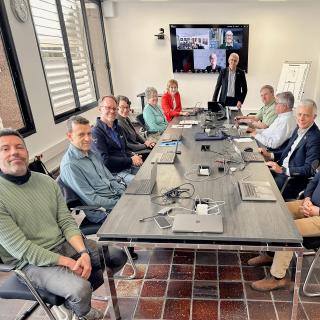
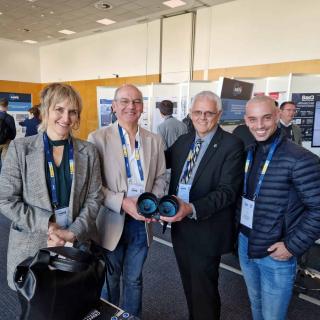
On 12 August, to mark the total eclipse that will be visible across much of Spain, various towns in Palencia — including the capital, Frómista and Carrión de los Condes — will host a series of observation and outreach events bringing together scientists and students from Spain, Morocco and the United States. This event will serve as a training exercise for the NATE experiment, which will take place in North Africa during the next total eclipse next year, and will act as a meeting point between depopulated areas of Spain, the outermost regions, and Moroccan, American and Spanish students and scientists.
The NATE (North African Telescope Eclipse) project is led by the Canary Islands Institute of Astrophysics (IAC), in collaboration with Mohammed VI Polytechnic University (UM6P) in Morocco and the National Solar Observatory (NSO) of the US National Science Foundation (NSF), and is supported by the Government of the Canary Islands through the Canary Islands Agency for Research, Innovation and the Information Society (ACIISI). This is a science, education and outreach initiative that will study the eclipse of 2 August 2027, visible in the southern tip of Spain, North Africa and the Middle East, using a coordinated network of telescopes operated by teams comprising scientific staff from the IAC and its partners, volunteers, teachers, secondary school pupils and university students.
This initiative is inspired by the successful Citizen CATE (Continental American Telescopic Eclipse) experiments carried out in the US during the 2017 and 2024 eclipses by the NSF, the NSO and the Southwest Research Institute (SwRI). NATE will use a total of ten telescopic instruments to observe the 2027 total solar eclipse in locations such as Tangier, Tetouan, El Jebha, Al Hoceima, Nador and Saidia. As the Moon’s shadow traverses Morocco, teams in these locations within the path of totality will capture images of the brilliance of the solar corona, extending the total duration of the observation to ten minutes.
A dress rehearsal in Palencia in 2026 to conduct scientific research in Morocco in 2027
Spain is set to experience a fortunate circumstance that occurs only on rare occasions: a succession of three solar eclipses of extraordinary significance – the total eclipses next summer and in 2027, and the annular eclipse in 2028. These astronomical phenomena, which combine scientific interest—as they offer exceptionally favourable conditions for studying the dynamics of the Sun through observation of the corona—with the public excitement arising from the fact that they cover a vast area, making them accessible to the entire population, are undoubtedly among those with the greatest impact on the collective imagination. All this makes them a great opportunity for the promotion and dissemination of interest in science.
The first, which will take place on 12 August and will have one of the points of greatest national and international interest in Palencia due to its proximity to the line of maximum duration, is not, however, the most favourable for NATE’s purposes, as the duration is insufficient and it occurs very low on the horizon, taking place almost at dusk. In contrast, the second, which will take place on 2 August 2027 and whose path of totality will cross southern Spain, Ceuta and Melilla, North Africa and part of the Middle East, will indeed offer more optimal conditions, both in terms of duration and height above the horizon.
However, this year’s event is ideal for team training and rehearsals for next year’s observation campaign. For this reason, scientists, volunteers, students and collaborators will be travelling to Palencia to receive on-site training and learn how to operate the equipment in real-world conditions, all in full view of the local public and any interested visitors.
Cerro de Otero and the Eclipse Fair
This gathering of experts and the general public will make Palencia one of the key locations for observing the eclipse. For this reason, the IAC and its partners, together with the town councils of Palencia and Frómista, will offer a comprehensive programme of activities which, from 10 August, will bring science and public outreach onto the streets with a range of fun and festive events that will highlight the historical significance of the moment.
Cerro del Otero, one of the capital’s most recognisable and iconic landmarks, will be the epicentre of both the training and observation activities and the programme of performances and events, alongside other strategic locations in Frómista and Carrión de los Condes. A programme designed for all families, bringing together leading national and international eclipse experts, musical performances and comedy sketches, whilst the public can explore the varied offerings at the various stalls.
A perfect prelude and accompaniment to what will be the grand spectacle reaching its climax at 8.29 pm on Wednesday 12 August, when the sun’s disc will be completely covered and darkness will reign momentarily. An unforgettable moment which, in the case of the NATE project, will continue twelve months later with the ambitious initiative covering the entire path of the eclipse across Morocco.