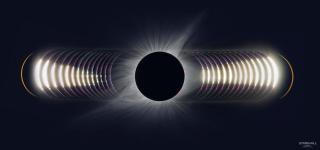
Ahead of the upcoming solar eclipse on August 12, the Instituto de Astrofísica de Canarias (IAC), in collaboration with the research group Predictive Science Inc. (PSI, San Diego, California), has successfully simulated in high detail the structure of the solar corona that will be visible during totality along the path of totality, including Palencia, where the IAC will gather more than 40 spanish, moroccan, and american astronomers. To process this complex three-dimensional calculation, the computing power of the supercomputing node )Supercomputador La Palma) was utilized, along with code adaptation created by PSI and carried out by the Specialized IT Service (SIE) of the IAC.
The solar corona—the outermost part of the Sun—is shaped by the magnetic fields of the solar surface. To construct the simulation, scientists used data continuously measured by NASA's SDO and ESA's Solar Orbiter satellites, as well as the international GONG (Global Oscillation Network Group) network, which has one of its key stations at the Observatorio del Teide (Tenerife), managed by the IAC.
Since it is not possible to observe the entire Sun simultaneously, the model reconstructs the distribution of the magnetic field by stitching together observations taken strip by strip over a full solar rotation. With this starting magnetic map, the La Palma Supercomputer solved highly complex magnetohydrodynamic (MHD) equations to predict how the structures and 'streamers' of the corona will form on the day of the eclipse.
Live Science to Understand the Sun
Beyond an aesthetic prediction, this work has a scientific goal: to unravel the problem of coronal heating, one of the greatest mysteries in solar and stellar physics. While the surface of the Sun is around 6,000 °C, the corona reaches temperatures of millions of degrees. By comparing the actual images captured during the eclipse with the numerical prediction made before the event, astrophysicists will be able to evaluate the accuracy of their models, correct thermal balance hypotheses, and learn which physical processes dominate heating in this part of the Sun, which is only visible from Earth during a total solar eclipse.
Understanding the dynamics of the corona is important for advancing space weather, as these magnetic structures directly influence solar storms that affect telecommunications networks, orbiting satellites, and technology on Earth.
NATE: The Science of Eclipses from Palencia
The IAC is immersed in the NATE project, which will observe the solar corona from Palencia. The North African Telescope Eclipse (NATE) project, led by the Instituto de Astrofísica de Canarias (IAC), is born in Palencia on August 12 to consolidate itself one year later in Morocco on the occasion of the total solar eclipse on August 2, 2027. A line of cooperation that will unite the outermost island region, rural Spain, and North Africa in a common effort. The project has the support of the Government of the Canary Islands.
This initiative builds on the experience accumulated by the successful Citizen CATE (Continental American Telescopic Eclipse) experiments, carried out in the United States during the 2017 and 2024 eclipses, and launched by the National Solar Observatory (NSO) of the National Science Foundation and the Southwest Research Institute of the United States.
Citizen Science in Pursuit of the Solar Corona
The NATE project, launched by the IAC alongside other institutions such as the Mohammed VI Polytechnic University (UM6P) and the NSO, will establish in Morocco in 2027 a coordinated network of stations equipped with telescopes operated by teams of secondary school and university students and teachers from the three participating countries, as well as astronomers and engineers from the IAC, UM6P, and NSO.
Prior to that, during this year's eclipse in Palencia, crucial testing and training of the various teams will take place. The scientific work will be carried out in full view of the public, and the team of experts will also deploy over three days across Palencia and its surroundings to share a passion for science, astronomy, and solar physics, and to rediscover the sky as a source of inspiration.
The team will lead talks, workshops, and safe solar observation points, coordinate the communication script and safety signage, and serve as a bridge between scientific work and public participation. In this way, while the protocol and data stream for the NATE network are tested with the scientific team and students, the public will enjoy an entertaining and festive day with accessible activities.
Featured Image and Interactive Tools
The IAC website displays the specific simulation corresponding to the view from Palencia. Furthermore, users and researchers can explore the prediction in real time and select any geographical point using the interactive map developed by the team:
- Global simulation and local view: https://www.iac.es/en
- Interactive local prediction map: https://eclipse.predsci.com/local-view