
Bibcode
Kopylov, A. I.; Tikhonov, N. A.; Fabrika, S.; Drozdovsky, I.; Valeev, A. F.
Bibliographical reference
Monthly Notices of the Royal Astronomical Society: Letters, Volume 387, Issue 1, pp. L45-L49.
Advertised on:
6
2008
Citations
21
Refereed citations
19
Description
We present the first photometry of individual stars within VV124
(UGC4879) and find that this is the most isolated dwarf galaxy in the
periphery of the Local Group. This work is based on imaging and
spectroscopic follow-up observations with the 6-m BTA telescope; we
resolve VV124 into 1560 stars down to the limiting magnitude levels of V
~= 25.6 and I ~= 23.9. Young blue stellar populations and ionized gas
are found near the core, but notably displaced from the centre of the
galaxy as traced by dominant evolved red stars. The mean heliocentric
radial velocity derived from the spectra of two blue supergiant stars
and unresolved continuum sources is -70 +/- 15kms-1. The
evolved `red tangle' stellar populations, which contain the red giant
branch (RGB), are identified at large galactocentric radii. We use the
I-band luminosity function to determine the distance based on the Tip of
RGB method, 1.1 +/- 0.1Mpc. This is ~10 times closer than the values
usually assumed in the literature, and we provide revised
distance-dependent parameters. From the mean (V - I) colour of the RGB,
we estimate the mean metallicity as [Fe/H] ~= -1.37 dex. Despite its
isolated location, the properties of VV124 are clearly not those of a
galaxy in formation, but rather similar to a transitional dIrr/dSph
type.
Related projects
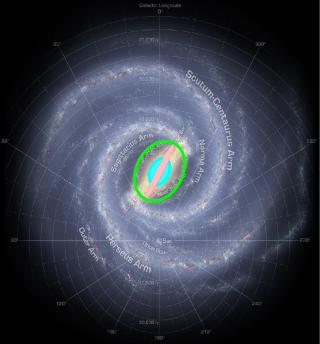
Milky Way and Nearby Galaxies
The overall aim of the project is to study the morphology, stellar populations, kinematics and dynamics (including formation and evolution) of the Milky Way and its satellite galaxies and other Local Group galaxies. The project can be divided into two main lines: I. Structure of the Milky Way and nearby galaxies. The detailed study of the
Martín
López Corredoira