
Bibcode
Saviane, I.; Exter, K.; Tsamis, Y.; Gallart, C.; Péquignot, D.
Bibliographical reference
Astronomy and Astrophysics, Volume 494, Issue 2, 2009, pp.515-525
Advertised on:
2
2009
Journal
Citations
10
Refereed citations
8
Description
Context: A planetary nebula (PN) candidate was discovered during FORS
imaging of the Local Group dwarf galaxy Phoenix. Aims: We use
this PN to complement abundances from red-giant stars. Methods:
FORS spectroscopy was used to confirm the PN classification. Empirical
methods and photoionization modeling were used to derive elemental
abundances from the emission line fluxes and to characterize the central
star. Results: For the elements deemed most reliable for
measuring the metallicity of the interstellar medium (ISM) from which
the PN formed, [O/H] ~ -0.46 and [Ar/H] ~ -1.03. [O/H] has lower
measurement errors but greater uncertainties due to the unresolved issue
of oxygen enrichment in the PN precursor star. Conclusions:
Earlier than 2 Gyr ago (the lower limit of the derived age for the
central star) the ISM had Z = 0.002-0.008, a range slightly more
metal-rich than the one provided by stars. Comparing our PN-to-stellar
values to surveys of other dwarf Local Group galaxies, Phoenix appears
to be an outlier.
Related projects
Milky Way and Nearby Galaxies
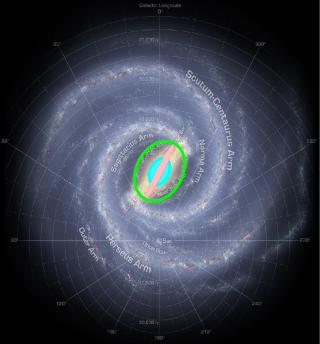
The overall aim of the project is to study the morphology, stellar populations, kinematics and dynamics (including formation and evolution) of the Milky Way and its satellite galaxies and other Local Group galaxies. The project can be divided into two main lines: I. Structure of the Milky Way and nearby galaxies. The detailed study of the
Martín
López Corredoira