
Bibcode
Calamida, A.; Bono, G.; Stetson, P. B.; Freyhammer, L. M.; Piersimoni, A. M.; Buonanno, R.; Caputo, F.; Cassisi, S.; Castellani, M.; Corsi, C. E.; Dall'Ora, M.; Degl'Innocenti, S.; Ferraro, I.; Grundahl, F.; Hilker, M.; Iannicola, G.; Monelli, M.; Nonino, M.; Patat, N.; Pietrinferni, A.; Prada Moroni, P. G.; Primas, F.; Pulone, L.; Richtler, T.; Romaniello, M.; Storm, J.; Walker, A. R.
Bibliographical reference
The Astrophysical Journal, Volume 706, Issue 2, pp. 1277-1298 (2009).
Advertised on:
12
2009
Journal
Citations
60
Refereed citations
49
Description
We present new intermediate-band Strömgren photometry based on more
than 300 u, v, b, y images of the Galactic globular cluster ω Cen.
Optical data were supplemented with new multiband near-infrared (NIR)
photometry (350 J, H, Ks images). The final optical-NIR
catalog covers a region of more than 20 × 20 arcmin squared across
the cluster center. We use different optical-NIR color-color planes
together with proper-motion data available in the literature to identify
candidate cluster red-giant (RG) stars. By adopting different
Strömgren metallicity indices, we estimate the photometric
metallicity for ≈4000 RGs, the largest sample ever collected. The
metallicity distributions show multiple peaks ([Fe/H]phot =
-1.73 ± 0.08, -1.29 ± 0.03, -1.05 ± 0.02, -0.80
± 0.04, -0.42 ± 0.12, and -0.07 ± 0.08 dex) and a
sharp cutoff in the metal-poor (MP) tail ([Fe/H]phot lsim -2
dex) that agree quite well with spectroscopic measurements. We identify
four distinct subpopulations, namely, MP ([Fe/H] <= -1.49),
metal-intermediate (MI; -1.49 < [Fe/H] <= -0.93), metal-rich (MR;
-0.95 < [Fe/H] <= -0.15), and solar metallicity ([Fe/H] ≈ 0).
The last group includes only a small fraction of stars (~8% ± 5%)
and should be confirmed spectroscopically. Moreover, using the
difference in metallicity based on different photometric indices, we
find that the 19% ± 1% of RGs are candidate CN-strong stars. This
fraction agrees quite well with recent spectroscopic estimates and could
imply a large fraction of binary stars. The Strömgren metallicity
indices display a robust correlation with α-elements ([Ca+Si/H])
when moving from the MI to the MR regime ([Fe/H] gsim -1.7 dex).
Based on observations collected in part with the 1.54 m Danish Telescope
and with the NTT@ESO Telescope operated in La Silla, and in part with
the VLT@ESO Telescope operated in Paranal. The Strömgren data were
collected with DFOSC2@Danish (proprietary data), while the NIR data were
collected with SOFI@NTT, proposals: 66.D-0557 and 68D-0545 (proprietary
data), 073.D-0313 and 59.A-9004 (ESO Science archive) and with
ISAAC@VLT, proposal 075.D-0824 (proprietary data).
Related projects
Milky Way and Nearby Galaxies
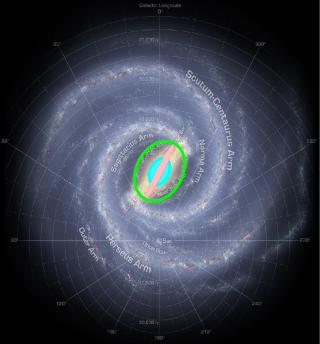
The overall aim of the project is to study the morphology, stellar populations, kinematics and dynamics (including formation and evolution) of the Milky Way and its satellite galaxies and other Local Group galaxies. The project can be divided into two main lines: I. Structure of the Milky Way and nearby galaxies. The detailed study of the
Martín
López Corredoira