
Bibcode
Liu, Y.; Sun, H.; Xu, D.; Svinkin, D. S.; Delaunay, J.; Tanvir, N. R.; Gao, H.; Zhang, C.; Chen, Y.; Wu, X. -F.; Zhang, B.; Yuan, W.; An, J.; Bruni, G.; Frederiks, D. D.; Ghirlanda, G.; Hu, J. -W.; Li, A.; Li, C. -K.; Li, J. -D.; Malesani, D. B.; Piro, L.; Raman, G.; Ricci, R.; Troja, E.; Vergani, S. D.; Wu, Q. -Y.; Yang, J.; Zhang, B. -B.; Zhu, Z. -P.; de Ugarte Postigo, A.; Demin, A. G.; Dobie, D.; Fan, Z.; Fu, S. -Y.; Fynbo, J. P. U.; Geng, J. -J.; Gianfagna, G.; Hu, Y. -D.; Huang, Y. -F.; Jiang, S. -Q.; Jonker, P. G.; Julakanti, Y.; Kennea, J. A.; Kokomov, A. A.; Kuulkers, E.; Lei, W. -H.; Leung, J. K.; Levan, A. J.; Li, D. -Y.; Li, Y.; Littlefair, S. P.; Liu, X.; Lysenko, A. L.; Ma, Y. -N.; Martin-Carrillo, A.; O'Brien, P.; Parsotan, T.; Quirola-Vásquez, J.; Ridnaia, A. V.; Ronchini, S.; Rossi, A.; Mata-Sánchez, D.; Schneider, B.; Shen, R. -F.; Thakur, A. L.; Tohuvavohu, A.; Torres, M. A. P.; Tsvetkova, A. E.; Ulanov, M. V.; Wei, J. -J.; Xiao, D.; Yin, Y. -H. I.; Bai, M.; Burwitz, V.; Cai, Z. -M.; Chen, F. -S.; Chen, H. -L.; Chen, T. -X.; Chen, W.; Chen, Y. -F.; Chen, Y. -H.; Cheng, H. -Q.; Cordier, B.; Cui, C. -Z.; Cui, W. -W.; Dai, Y. -F.; Dai, Z. -G.; Eder, J.; Eyles-Ferris, R. A. J.; Fan, D. -W.; Feldman, C.; Feng, H.; Feng, Z.; Friedrich, P.; Gao, X.; Gonzalez, J. -F.; Guan, J.; Han, D. -W.; Han, J. et al.
Bibliographical reference
Nature Astronomy
Advertised on:
4
2025
Citations
81
Refereed citations
71
Description
Long gamma-ray bursts (GRBs) are believed to originate from core collapse of massive stars. High-redshift GRBs can probe the star formation and reionization history of the early Universe, but their detection remains rare. Here we report the detection of a GRB triggered in the 0.5-4 keV band by the Wide-field X-ray Telescope (WXT) on board the Einstein Probe (EP) mission, designated as EP240315a, whose bright peak was also detected by the Swift Burst Alert Telescope and Konus-Wind through off-line analyses. At a redshift of z = 4.859, EP240315a showed a much longer and more complicated light curve in the soft-X-ray band than in gamma rays. Benefiting from a large field of view (~3,600°2) and a high sensitivity, EP-WXT captured the earlier engine activation and extended late engine activity through a continuous detection. With a peak X-ray flux at the faint end of previously known high-z GRBs, the detection of EP240315a demonstrates the great potential for EP to study the early universe via GRBs.
Related projects
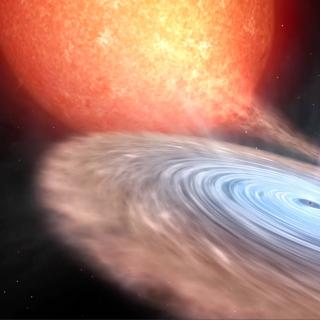
Black holes, neutron stars, white dwarfs and their local environment
Accreting black-holes and neutron stars in X-ray binaries provide an ideal laboratory for exploring the physics of compact objects, yielding not only confirmation of the existence of stellar mass black holes via dynamical mass measurements, but also the best opportunity for probing high-gravity environments and the physics of accretion; the most
Montserrat
Armas Padilla