
Bibcode
Saavedra, E. A.; Muñoz-Darias, T.; Torres, M. A. P.; Yanes-Rizo, I. V.; Armas Padilla, M.; Álvarez-Hernández, A.; Casares, J.; Mata Sánchez, D.; Rout, S. K.; Navarro, S.
Bibliographical reference
Astronomy and Astrophysics
Advertised on:
10
2025
Journal
Citations
3
Refereed citations
3
Description
The neutron star X-ray transient MAXI J1807+132 underwent outbursts in 2017, 2019, and 2023. We conducted an R-band time series photometry campaign using the Isaac Newton Telescope during the 2022 quiescent state. We detected a periodic variation in the light curve that is consistent with ellipsoidal modulation, which allowed us to determine an orbital period of Porb = 4.258 ± 0.008 h. By modelling the light curve, we obtained a binary inclination of i = 72 ± 5 deg and a mass ratio q = 0.24+0.19‑0.14 (68% confidence level). Furthermore, our analysis indicates the presence of an early M-dwarf companion that contributes between 30 and 50% to the total flux in the R band. We have extended the previously established absolute magnitude versus orbital period correlation for black hole X-ray transients to neutron star systems. We applied the correlation to MAXI J1807+132, estimating its distance to be 6.3 ± 0.7 kpc and its height above the Galactic plane to be 1.6 ± 0.2 kpc.
Related projects
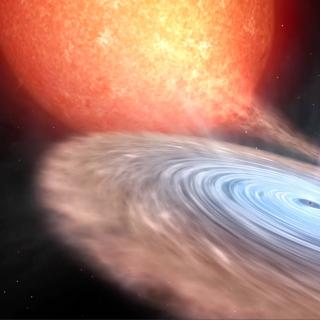
Black holes, neutron stars, white dwarfs and their local environment
Accreting black-holes and neutron stars in X-ray binaries provide an ideal laboratory for exploring the physics of compact objects, yielding not only confirmation of the existence of stellar mass black holes via dynamical mass measurements, but also the best opportunity for probing high-gravity environments and the physics of accretion; the most
Montserrat
Armas Padilla