
Bibcode
Bernard, E. J.; Ferguson, Annette M. N.; Richardson, Jenny C.; Irwin, Mike J.; Barker, Michael K.; Hidalgo, S. L.; Aparicio, A.; Chapman, Scott C.; Ibata, Rodrigo A.; Lewis, Geraint F.; McConnachie, Alan W.; Tanvir, Nial R.
Bibliographical reference
Monthly Notices of the Royal Astronomical Society, Volume 446, Issue 3, p.2789-2801
Advertised on:
1
2015
Citations
74
Refereed citations
64
Description
While wide-field surveys of M31 have revealed much substructure at large
radii, understanding the nature and origin of this material is not
straightforward from morphology alone. Using deep Hubble Space
Telescope/Advanced Camera for Surveys data, we have derived further
constraints in the form of quantitative star formation histories (SFHs)
for 14 inner halo fields which sample diverse substructures. In
agreement with our previous analysis of colour-magnitude diagram
morphologies, we find the resultant behaviours can be broadly separated
into two categories. The SFHs of `disc-like' fields indicate that most
of their mass has formed since z ˜ 1, with one quarter of the mass
formed in the last 5 Gyr. We find `stream-like' fields to be on average
1.5 Gyr older, with ≲ 10 per cent of their stellar mass formed
within the last 5 Gyr. These fields are also characterized by an
age-metallicity relation showing rapid chemical enrichment to solar
metallicity by z = 1, suggestive of an early-type progenitor. We confirm
a significant burst of star formation 2 Gyr ago, discovered in our
previous work, in all the fields studied here. The presence of these
young stars in our most remote fields suggests that they have not formed
in situ but have been kicked-out from the thin disc through disc heating
in the recent past.
Related projects
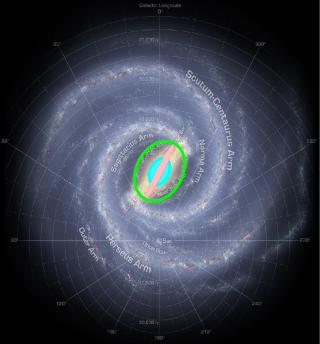
Milky Way and Nearby Galaxies
The overall aim of the project is to study the morphology, stellar populations, kinematics and dynamics (including formation and evolution) of the Milky Way and its satellite galaxies and other Local Group galaxies. The project can be divided into two main lines: I. Structure of the Milky Way and nearby galaxies. The detailed study of the
Martín
López Corredoira