
Bibcode
Rodriguez, Antonio C.; El-Badry, Kareem; Hakala, Pasi; Rodríguez-Gil, Pablo; Bao, Tong; Galiullin, Ilkham; Kurlander, Jacob A.; Law, Casey J.; Pelisoli, Ingrid; Schreiber, Matthias R.; Burdge, Kevin; Caiazzo, Ilaria; Roestel, Jan van; Szkody, Paula; Drake, Andrew J.; Buckley, David A. H.; Potter, Stephen B.; Gaensicke, Boris; Mori, Kaya; Bellm, Eric C.; Kulkarni, Shrinivas R.; Prince, Thomas A.; Graham, Matthew; Kasliwal, Mansi M.; Rose, Sam; Sharma, Yashvi; Ahumada, Tomás; Anand, Shreya; Viitanen, Akke; Wold, Avery; Chen, Tracy X.; Riddle, Reed; Smith, Roger
Bibliographical reference
Publications of the Astronomical Society of the Pacific
Advertised on:
2
2025
Citations
7
Refereed citations
7
Description
White dwarfs (WDs) are the most abundant compact objects, and recent surveys have suggested that over a third of WDs in accreting binaries host a strong (B ≳ 1 MG) magnetic field. However, the origin and evolution of WD magnetism remain under debate. Two WD pulsars, AR Sco and J191213.72–441045.1 (J1912), have been found, which are non-accreting binaries hosting rapidly spinning (1.97 minutes and 5.30 minutes, respectively) magnetic WDs. The WD in AR Sco is slowing down on a yr timescale. It is believed they will eventually become polars, accreting systems in which a magnetic WD (B ≈ 10‑240 MG) accretes from a Roche lobe-filling donor spinning in sync with the orbit (≳78 minutes). Here, we present multiwavelength data and analysis of Gaia22ayj, which outbursted in 2022 March. We find that Gaia22ayj is a magnetic accreting WD that is rapidly spinning down ( yr) like WD pulsars, but shows clear evidence of accretion, like polars. Strong linear polarization (40%) is detected in Gaia22ayj; such high levels have only been seen in the WD pulsar AR Sco and demonstrate the WD is magnetic. High speed photometry reveals a 9.36 minutes period accompanying a high amplitude (∼2 mag) modulation. We associate this with a WD spin or spin–orbit beat period, not an orbital period as was previously suggested. Fast (60 s) optical spectroscopy reveals a broad "hump," reminiscent of cyclotron emission in polars, between 4000 and 8000 Å. We find an X-ray luminosity of in the 0.3–8 keV energy range, while two very large array radio campaigns resulted in a non-detection with a Fr < 15.8 μJy 3σ upper limit. The shared properties of both WD pulsars and polars suggest that Gaia22ayj is a missing link between the two classes of magnetic WD binaries.
Related projects
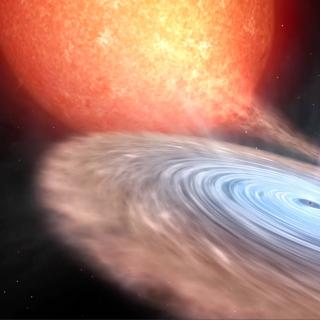
Black holes, neutron stars, white dwarfs and their local environment
Accreting black-holes and neutron stars in X-ray binaries provide an ideal laboratory for exploring the physics of compact objects, yielding not only confirmation of the existence of stellar mass black holes via dynamical mass measurements, but also the best opportunity for probing high-gravity environments and the physics of accretion; the most
Montserrat
Armas Padilla