
Bibcode
Larison, C.; Pierel, J. D. R.; Newman, M. J. B.; Jha, S. W.; Gilman, D.; Hayes, E. E.; Agrawal, A.; Arendse, N.; Birrer, S.; Bronikowski, M.; Chakrabarti, S.; Della Costa, J. M.; Coulter, D. A.; Courbin, F.; Dalrymple, K. A.; Dhawan, S.; Diego, J. M.; Gall, C.; Goobar, A.; Hjorth, J.; Huang, X.; Johansson, J.; Mao, S.; Marques-Chaves, R.; Mazzali, P. A.; More, A.; Moustakas, L. A.; Pérez-Fournon, I.; Petrushevska, T.; Poidevin, F.; Rest, A.; Shajib, A. J.; Shirley, R.; Strolger, L. G.; Suyu, S. H.; Treu, T.; Zenati, Y.
Bibliographical reference
The Astrophysical Journal
Advertised on:
2
2025
Journal
Citations
12
Refereed citations
9
Description
Strongly lensed supernovae (SNe) are a rare class of transient that can offer tight cosmological constraints that are complementary to methods from other astronomical events. We present a follow-up study of one recently discovered strongly lensed SN, the quadruply imaged type Ia SN 2022qmx (aka "SN Zwicky"), at z = 0.3544. We measure updated, template-subtracted photometry for SN Zwicky and derive improved time delays and magnifications. This is possible because SNe are transient, fading away after reaching their peak brightness. Specifically, we measure point-spread-function photometry for all four images of SN Zwicky in three Hubble Space Telescope WFC3/UVIS passbands (F475W, F625W, and F814W) and one WFC3/IR passband (F160W), with template images taken ∼11 months after the epoch in which the SN images appear. We find consistency to within 2σ between lens-model-predicted time delays (≲1 day) and measured time delays with HST colors (≲2 days), including the uncertainty from chromatic microlensing that may arise from stars in the lensing galaxy. The standardizable nature of SNe Ia allows us to estimate absolute magnifications for the four images, with images A and C being elevated in magnification compared to lens model predictions by about 6σ and 3σ, respectively, confirming previous work. We show that millilensing or differential dust extinction is unable to explain these discrepancies, and we find evidence for the existence of microlensing in images A, C, and potentially D that may contribute to the anomalous magnification.
Related projects
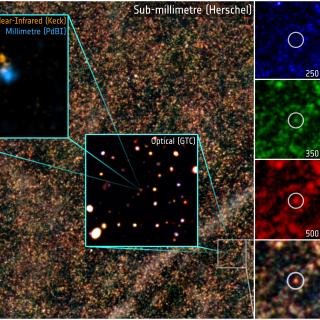
Formation and Evolution of Galaxies: Observations in Infrared and other Wavelengths
This IAC research group carries out several extragalactic projects in different spectral ranges, using space as well as ground-based telescopes, to study the cosmological evolution of galaxies and the origin of nuclear activity in active galaxies. The group is a member of the international consortium which built the SPIRE instrument for the
Ismael
Pérez Fournon