
Bibcode
Walker, A.; Monelli, M.; Matsunaga, N.; Iannicola, G.; Gilmozzi, R.; Ferraro, I.; Calamida, A.; Buonanno, R.; Aparicio, A.; Dall'Ora, M.; Prada Moroni, P. G.; Bono, G.; Stetson, P. B.; Milone, A. P.; Lagioia, E. P.
Bibliographical reference
The Astrophysical Journal, Volume 782, Issue 1, article id. 50, 11 pp. (2014).
Advertised on:
2
2014
Journal
Citations
29
Refereed citations
26
Description
We present deep and precise multi-band photometry of the Galactic bulge
globular cluster NGC 6528. The current data set includes optical and
near-infrared images collected with ACS/WFC, WFC3/UVIS, and WFC3/IR on
board the Hubble Space Telescope. The images cover a time interval of
almost 10 yr, and we have been able to carry out a proper-motion
separation between cluster and field stars. We performed a detailed
comparison in the m F814W, m F606W – m
F814W color-magnitude diagram with two empirical calibrators
observed in the same bands. We found that NGC 6528 is coeval with and
more metal-rich than 47 Tuc. Moreover, it appears older and more
metal-poor than the super-metal-rich open cluster NGC 6791. The current
evidence is supported by several diagnostics (red horizontal branch, red
giant branch bump, shape of the sub-giant branch, slope of the main
sequence) that are minimally affected by uncertainties in reddening and
distance. We fit the optical observations with theoretical isochrones
based on a scaled-solar chemical mixture and found an age of 11 ±
1 Gyr and an iron abundance slightly above solar ([Fe/H] = +0.20). The
iron abundance and the old cluster age further support the recent
spectroscopic findings suggesting a rapid chemical enrichment of the
Galactic bulge.
Related projects
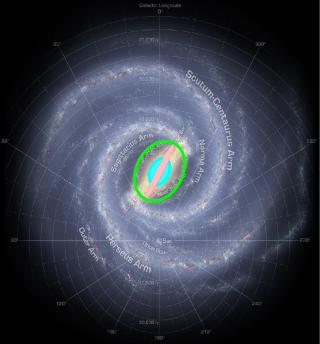
Milky Way and Nearby Galaxies
The overall aim of the project is to study the morphology, stellar populations, kinematics and dynamics (including formation and evolution) of the Milky Way and its satellite galaxies and other Local Group galaxies. The project can be divided into two main lines: I. Structure of the Milky Way and nearby galaxies. The detailed study of the
Martín
López Corredoira