
Bibcode
Zhang, Jerry J. -Y.; Lodieu, Nicolas; Martín, Eduardo L.; Tremblin, Pascal; Zapatero Osorio, María Rosa; Béjar, Víctor J. S.; Vitas, Nikola; Gauza, Bartosz; Pavlenko, Yakiv V.; Rebolo, Rafael
Bibliographical reference
The Astrophysical Journal
Advertised on:
5
2025
Journal
Citations
2
Refereed citations
1
Description
WISEA J181006.18‑101000.5 (WISE1810) is the nearest metal-poor ultracool dwarf to the Sun. It has a low effective temperature and has been classified as an extreme early-T subdwarf. However, methane, the characteristic molecule of the spectral class T, was not seen in the previous low-resolution spectrum. Using the 10.4 m Gran Telescopio Canarias, we collected a high-quality JHK-band intermediate-resolution R ≈ 5000 spectrum of WISE1810, in which 17 ± 6 ppm of methane is clearly detected, while carbon monoxide is absent. Based on a custom computed ATMO2020++ model, we estimated an effective temperature of 1000 ± 100 K, a high surface gravity of dex, and a carbon abundance of [C/H] = ‑1.5 ± 0.2 dex, inferring [Fe/H] = ‑1.7 ± 0.2 dex. Potassium is not seen in our data, and the upper limits of the pseudoequivalent width of the J-band atomic lines are at least 25–60 times weaker than those measured from solar-metallicity early-T counterparts. We measured a heliocentric radial velocity of ‑83 ± 13 km s‑1, inferring that WISE1810 is more likely a thick-disk member. *Based on observations made with the Gran Telescopio Canarias.
Related projects
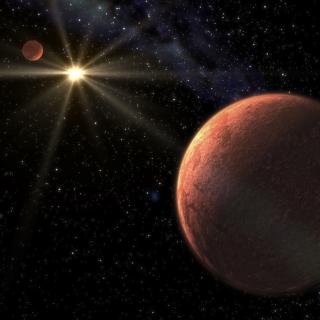
Very Low Mass Stars, Brown Dwarfs and Planets
Our goal is to study the processes that lead to the formation of low mass stars, brown dwarfs and planets and to characterize the physical properties of these objects in various evolutionary stages. Low mass stars and brown dwarfs are likely the most numerous type of objects in our Galaxy but due to their low intrinsic luminosity they are not so
Rafael
Rebolo López

Exoplanets and Astrobiology
The search for life in the universe has been driven by recent discoveries of planets around other stars (known as exoplanets), becoming one of the most active fields in modern astrophysics. The growing number of new exoplanets discovered in recent years and the recent advance on the study of their atmospheres are not only providing new valuable
Enric
Pallé Bago