
Bibcode
Łokas, E. L.; Ebrová, I.; del Pino, A.; Semczuk, M.
Bibliographical reference
Monthly Notices of the Royal Astronomical Society: Letters, Volume 445, Issue 1, p.L6-L10
Advertised on:
11
2014
Citations
36
Refereed citations
29
Description
Using N-body simulations, we study the origin of prolate rotation
observed in the kinematic data for Andromeda II (And II), a dwarf
spheroidal satellite of M31. We propose an evolutionary model for the
origin of And II involving a merger between two discy dwarf galaxies
with different disc scalelengths. The dwarfs are placed on a radial
orbit towards each other with their angular momenta inclined by 90 deg.
The merger remnant forms a stable triaxial galaxy with rotation only
around the longest axis whose origin is naturally explained as due to
the symmetry of the initial configuration and the conservation of
angular momentum components along the direction of the merger. The stars
originating from the two dwarfs show significantly different surface
density profiles while having very similar kinematics as required by the
data. We also study an alternative scenario for the formation of And II,
via tidal stirring of a discy dwarf. While intrinsic rotation occurs
naturally in this model as a remnant of the initial rotation of the
disc, it is mostly around the shortest axis of the stellar component. We
conclude that the velocity distribution in And II is much more naturally
explained by a scenario involving a past merger.
Related projects
Milky Way and Nearby Galaxies
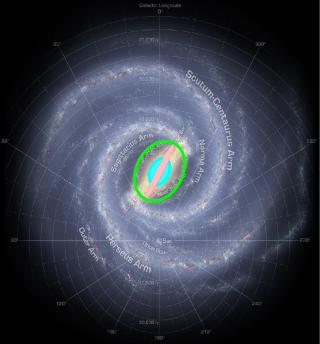
The overall aim of the project is to study the morphology, stellar populations, kinematics and dynamics (including formation and evolution) of the Milky Way and its satellite galaxies and other Local Group galaxies. The project can be divided into two main lines: I. Structure of the Milky Way and nearby galaxies. The detailed study of the
Martín
López Corredoira