Magnetism, Polarization and Radiative Transfer in Astrophysics

    General
    Description

    Magnetic fields pervade all astrophysical plasmas and govern most of the variability in the Universe at intermediate time scales. They are present in stars across the whole Hertzsprung-Russell diagram, in galaxies, and even perhaps in the intergalactic medium. Polarized light provides the most reliable source of information at our disposal for the remote sensing of astrophysical magnetic fields, including those on the Sun. In particular, the diagnostics of solar and stellar magnetic fields requires the measurement and physical interpretation of polarization signatures in spectral lines, which are induced by various physical mechanisms taking place at the atomic level. In addition to the familiar Zeeman effect, polarization can also be generated by various other physical processes, such as atomic level polarization induced by anisotropic pumping mechanisms, quantum interference between fine-structured or hyperfine-structured energy levels, the Hanle effect, etc. Interestingly, the polarization produced by such mechanisms is sensitive to the physical conditions of the astrophysical plasma under consideration and, in particular, to the presence of magnetic fields in a parameter domain that goes from field intensities as small as 1 micro-G to many thousands of Gauss.

    The main objective of this project is to explore in depth the physics and origin of polarized radiation in astrophysical plasmas as well as its diagnostic use for understanding cosmical magnetic fields, with emphasis on the magnetism of the extended solar atmosphere. Our investigations deal with:

    -the theoretical understanding of relevant polarization physics, which requires new insights into the quantum theory of polarized light scattering in the presence of magnetic and electric fields.

    -the development of plasma diagnostic tools for the investigation of astrophysical magnetic fields, with emphasis on the magnetism of the extended solar atmosphere, circumstellar envelopes and planetary nebulae.

    -spectropolarimetric observations and their physical interpretation.

    -radiative transfer in three-dimensional models of stellar atmospheres, resulting from magneto-hydrodynamical simulations.

    -atomic and molecular spectroscopy and spectro-polarimetry, with applications in several fields of astrophysics.

    This research project is formed by a group of scientists convinced of the importance of complementing theoretical and observational investigations in order to face some of the present challenges of 21st century Astrophysics.

    Principal investigator
    1. We applied deep learning techniques to the analysis of observations. Using convolutional neural networks, we developed techniques for the deconvolution of observational data. These techniques were also used to accelerate the deconvolution process of ground-based observations, achieving a cadence of around a hundred images processed per second.
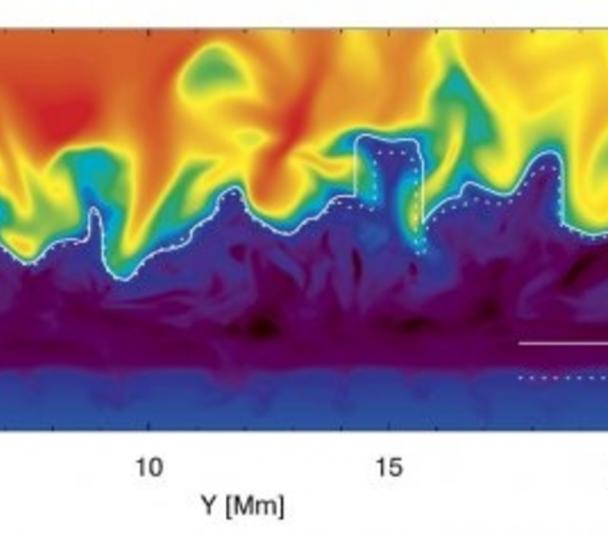
    2. We developed an inference technique based on bayesian statistics in order to interpret the observations provided by the CLASP international experiment. By parametrizing a state-of-the-art magneto-hydrodynamical model of the solar atmosphere, we found that the geometrical complexity of the transition region must be much more complex than the one provided by the model.
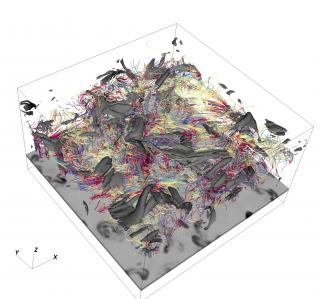
    3. We solved the problem of polarized radiation transfer in magneto-convection simulations that account for small-scale dynamo action for the Sr I line at 460.7 nm. We found that the model with most of the convection zone magnetized close to the equipartition and a surface mean field strength of 170G is compatible with the available observations.
    4. We studied the magnetic sensitivity of the Ca I line at 422.7nm. The linear polarization at the core is sensitive to the Hanle effect, while the linear polarization in the wings is sensitive to the magneto-optical effects, as a consequence of the newly found effect resulting from the joint action of partial redistribution and the Zeeman effects.
    5. We studied the formation of the H-alpha, Mg II h-k, and Ca II H-K and 845.2nm in a model atmosphere of a flaring bipolar active region, solving the radiation transfer problem taking into account partial redistribution in full 3D geometry and out of local thermodynamical equilibrium. We succeeded in reproducing common observational features of such flaring regions.

    Related publications

    Isotropic Inelastic Collisions in a Multiterm Atom with Hyperfine Structure 2015ApJ...812...73B
    CLASP: A UV Spectropolarimeter on a Sounding Rocket for Probing theChromosphere-Corona Transition Regio 2015IAUGA..2254536I
    Full Stokes observations in the He i 1083 nm spectral region covering an M3.2 flare 2015IAUS..305...73K
    Atomic Scattering Polarization. Observations, Modeling, Predictions 2015IAUS..305..127B
    The impact of surface dynamo magnetic fields on the chemical abundance determination 2015IAUS..305..368S
    Formation of polarized spectral lines in atmospheres with horizontal inhomogeneities 2015IAUS..305..401T
    Chromospheric Polarization in the Photospheric Solar Oxygen Infrared Triplet 2015ApJ...808L..13D
    The impact of surface dynamo magnetic fields on the solar iron abundance 2015A&A...579A.112S
    Spatial deconvolution of spectropolarimetric data: an application to quiet Sun magnetic elements 2015A&A...579A...3Q
    Sparse inversion of Stokes profiles. I. Two-dimensional Milne-Eddington inversions 2015A&A...577A.140A
    Estimating the magnetic field strength from magnetograms 2015A&A...577A.125A
    The solar oxygen abundance from an empirical three-dimensional model 2015A&A...577A..25S
    An open-source, massively parallel code for non-LTE synthesis and inversion of spectral lines and Zeeman-induced Stokes profiles 2015A&A...577A...7S
    The Differences in the Torus Geometry between Hidden and Non-hidden Broad Line Active Galactic Nuclei 2015ApJ...803...57I
    Three-dimensional Radiative Transfer Simulations of the Scattering Polarization of the Hydrogen Lyα Line in a Magnetohydrodynamic Model of the Chromosphere–Corona Transition Region 2015ApJ...803...65S
    Height Variation of the Vector Magnetic Field in Solar Spicules 2015ApJ...803L..18O
    Spectro-Polarimetric Imaging Reveals Helical Magnetic Fields in Solar Prominence Feet 2015ApJ...802....3M
    Chromospheric Diagnosis with Ca II Lines: Forward Modeling in Forward Scattering. I 2015ApJ...801...16C
    Magnetic and Dynamical Photospheric Disturbances Observed During an M3.2 Solar Flare 2015ApJ...799L..25K
    Constraining the shaping mechanism of the Red Rectangle through the spectro-polarimetry of its central star 2015A&A...574A..16M
    Hierarchical analysis of the quiet-Sun magnetism 2014A&A...572A..98A
    The Solar Internetwork. I. Contribution to the Network Magnetic Flux 2014ApJ...797...49G
    Synthetic Observations of Wave Propagation in a Sunspot Umbra 2014ApJ...795....9F
    Pair separation of magnetic elements in the quiet Sun 2014A&A...569A.121G
    High speed magnetized flows in the quiet Sun 2014A&A...569A..73Q
    Frequency Redistribution Function for the Polarized Two-term Atom 2014ApJ...791...94C
    Photospheric downward plasma motions in the quiet Sun 2014A&A...566A.139Q
    The magnetic field configuration of a solar prominence inferred from spectropolarimetric observations in the He i 10 830 Å triplet 2014A&A...566A..46O
    Depolarizing Collisions with Hydrogen: Neutral and Singly Ionized Alkaline Earths 2014ApJ...788..118M
    On the Inversion of the Scattering Polarization and the Hanle Effect Signals in the Hydrogen Lyα Line 2014ApJ...787..159I
    Determination of the cross-field density structuring in coronal waveguides using the damping of transverse waves 2014A&A...565A..78A
    Upper Limits to the Magnetic Field in Central Stars of Planetary Nebulae 2014ApJ...787..111A
    The transfer of resonance line polarization with partial frequency redistribution and J-state interference. Theoretical approach and numerical methods 2014A&A...564A..16B
    Time Evolution of Plasma Parameters during the Rise of a Solar Prominence Instability 2014ApJ...785L..10O
    Investigating the sensitivity of observed spectral energy distributions to clumpy torus properties in Seyfert galaxies 2014MNRAS.439.3847R
    A meta-analysis of the magnetic line broadening in the solar atmosphere 2014A&A...563A.114A
    A search for magnetic fields on central stars in planetary nebulae 2014A&A...563A..43L
    Non-coherent Continuum Scattering as a Line Polarization Mechanism 2014ApJ...784...46D
    Infrared Extinction in the Inner Milky Way through Red Clump Giants 2014ApJ...782...86G
    Search for surface magnetic fields in Mira stars. First detection in χ Cygni 2014A&A...561A..85L