News

This section includes scientific and technological news from the IAC and its Observatories, as well as press releases on scientific and technological results, astronomical events, educational projects, outreach activities and institutional events.

Displaying 19 - 24 of 518
Advertised on
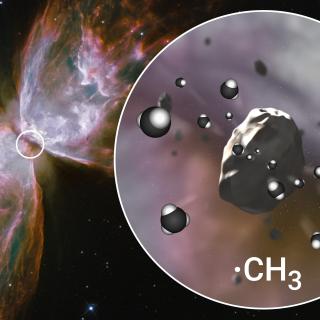
  • Artist's impression of the erosion of hydrogenated amorphous carbon grains in the dusty torus of a young carbon-rich planetary nebula, releasing methyl radicals (CH3) into the gas phase
    An international study led by researchers from the Instituto de Astrofísica de Canarias (IAC) reports the first secure detection of the methyl radical (CH₃) in the environment of an evolved, carbon-rich star. The molecule was found with the James Webb Space Telescope (JWST) in SMP LMC 011, a dying star in the Large Magellanic Cloud, and points to an unexpected way of building the carbon molecules that seed the Universe with organic material. The results are published in the prestigious journal The Astrophysical Journal Letters . The methyl radical, CH₃, is one of the simplest and most
    Advertised on
  • AI_poidevin_medium
    SN 2021lwz: Understanding an Unusual Stellar Explosion Discovery and Initial Mystery On May 10, 2021, astronomers detected a supernova called SN 2021lwz at a distance of approximately 900 million light-years from Earth. What made this event remarkable was its unusual behavior: it combined characteristics of different supernova types in ways that didn't fit established classifications, prompting an in-depth investigation. Why This Supernova Matters Supernovae are among the most energetic events in the universe, marking the violent deaths of massive stars. They help astronomers understand
    Advertised on
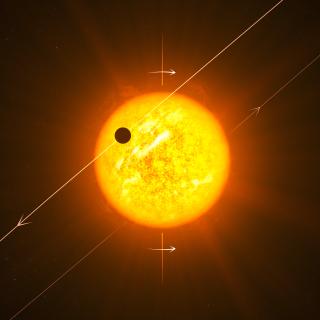
  • Artist’s impression of an exoplanet in a retrograde orbit
    Thanks to the NIRPS infrared spectrograph, built with the involvement of the Instituto de Astrofísica de Canarias , an international team led by the University of Geneva has been able to identify the unique orbit of the exoplanet GJ 3090 b. An international team, led by the University of Geneva (UNIGE) and including researchers from the Instituto de Astrofísica de Canarias (IAC), has determined the orbital configuration of the exoplanet GJ 3090 b using the NIRPS spectrograph, built with the participation of the IAC and installed on the 3.6-metre telescope at the La Silla Observatory (ESO
    Advertised on
  • IAC Logo
    On 18 September 2026, the Instituto de Astrofísica de Canarias (IAC) and the Ministry of Science, Innovation and Universities (MICIU) received a communication from the Executive Director of the TMT International Observatory (TIO) stating that its partners had been unable to reach the consensus required to accept the financial offer presented by the Ministry on 29 July to begin construction of the Thirty Meter Telescope (TMT) at the Roque de los Muchachos Observatory (ORM) on the island of La Palma. The proposal envisaged financing of up to €1 billion: a contribution from the Centre for the
    Advertised on
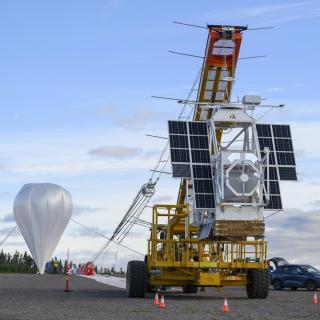
  • Momento del lanzamiento de Sunrise III
    El Instituto de Astrofísica de Canarias (IAC) y la Universidad de La Laguna ULL) y participan en la misión internacional Sunrise III, un observatorio solar estratosférico transportado por globo que permite estudiar la parte inferior de la atmósfera solar, desde la superficie del Sol hasta la cromosfera media, con una resolución espacial cercana a los 50 kilómetros sobre la superficie solar. En julio de 2024, Sunrise III completó con éxito un vuelo de casi una semana de duración, recorriendo la distancia que separa el norte de Suecia y el noroeste de Canadá, durante el cual recopiló alrededor
    Advertised on
  • desired
    H II regions are clouds of glowing, ionised gas associated with regions of recent star formation. By studying the light emitted by these regions, we can learn about their physical conditions and chemical composition, providing important clues about how stars and galaxies form and evolve. One of the key properties we need to know is the temperature of the gas. We can measure it from the emission lines of different chemical elements, which probe different parts of an H II region. However, it is not always possible to measure all these temperatures directly. In these cases, we need to estimate
    Advertised on