News

This section includes scientific and technological news from the IAC and its Observatories, as well as press releases on scientific and technological results, astronomical events, educational projects, outreach activities and institutional events.

Displaying 1 - 6 of 517
Advertised on
  • Distribution of dark matter in nearby galaxies
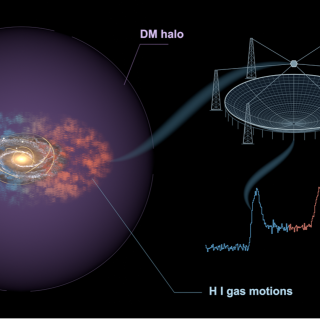
    Galaxies appear to hold a surprise beneath their visible stars: their inner regions contain less dark matter than some of our most advanced simulations predict. A study of 136 nearby galaxies, involving the Instituto de Astrofísica de Canarias (IAC), reveals a discrepancy that becomes more extensive in more massive systems, offering fresh clues about how galaxies form and evolve. Dark matter is invisible, but its gravitational pull helps govern the motions of stars and gas. By measuring these movements, astronomers can reconstruct where this unseen matter lies and test the computer
    Advertised on
  • Didymos before and after the DART probe’s impact
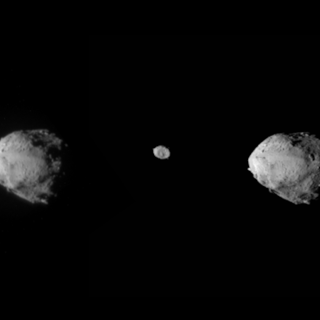
    On September 2022, the NASA DART probe impacted asteroid Dimorphos. After a two-year journey, the Hera spacecraft has arrived to the system and obtained unprecedented images of its current status after the impact. Dimorphos, the smaller (~150 m) of the two asteroids that form the binary system Didymos, was the main target of the NASA’s Double Asteroid Redirection Test (DART). It was impacted by the 576 kg DART probe at a velocity of 6.1 km/s, as part of a kinetic impactor test, the first Planetary Defence experiment to modify the orbit of an asteroid: the impact reduced the orbital period of
    Advertised on
  • Welopōʻai triple-star system
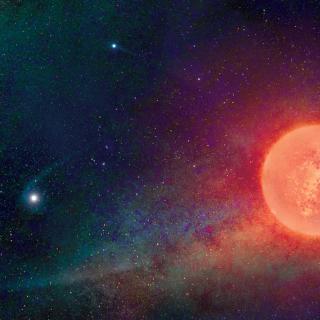
    An international team, including staff from the Canary Islands Institute of Astrophysics (IAC), has discovered a nearby stellar system that challenges our understanding of how stars live, die, and interact with one another. Located just 28 light-years from Earth, the newly characterized system contains three stars, including two white dwarfs - the dense stellar remnants left behind when Sun-like stars exhaust their fuel. The system, named Welopōʻai, is now the closest known triple-star system containing multiple white dwarfs and one of the most intriguing stellar laboratories in our cosmic
    Advertised on
  • El director del IAC, Valentín Martínez Pillet, inaugura la XXXVII Canary Islands Winter School of Astrophysics
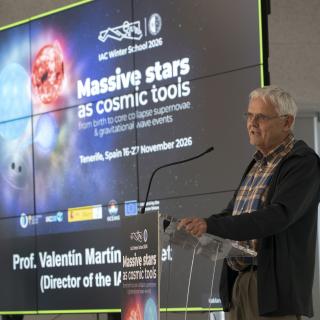
    Más de un centenar de estudiantes y jóvenes investigadores de una veintena de países participan en esta edición, que se celebra en Tenerife hasta el próximo 27 de noviembre y combina formación especializada, visitas a los observatorios y actividades abiertas al público. El Instituto de Astrofísica de Canarias (IAC) ha inaugurado hoy la XXXVII Canary Islands Winter School of Astrophysics, que este año está dedicada al estudio de las estrellas masivas y su papel en la evolución del Universo, desde su nacimiento hasta las supernovas de colapso de núcleo y los eventos de ondas gravitacionales
    Advertised on
  • Euclid’s view of the rich galaxy cluster Abell 3128
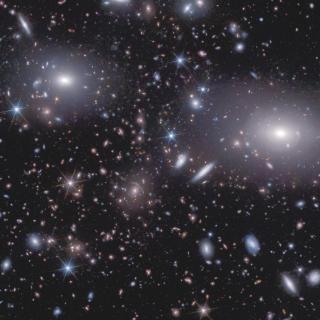
    The European Space Agency’s Euclid mission has released its first major batch of data. With this release, which captures the light of more than a billion objects and covers an area of sky as big as 9500 full Moons, ESA’s dark Universe ‘detective’ lays the foundation for its largest-ever 3D map of the cosmos. Launched in 2023, ESA’s Euclid space mission will map the sky for 6 years to create the largest and most accurate 3D map of the Universe. Spain has an important role in the mission, with a prominent role in the Euclid Consortium. The Instituto de Astrofísica de Canarias (IAC)
    Advertised on
  • New Scales for Measuring the Chemical Composition of the Universe
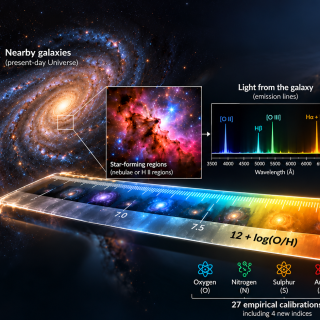
    An international team, with the participation of researchers from the Instituto de Astrofísica de Canarias (IAC), has developed a new generation of calibrations that make it possible to estimate the chemical composition (metallicity) of both nearby galaxies and the most distant and early galaxies in the Universe observed by the James Webb Space Telescope. The study is based on the analysis of the largest collection of high-quality spectroscopic observations gathered to date, the result of more than a decade of compilation and analysis work. To understand the origin and evolution of galaxies
    Advertised on