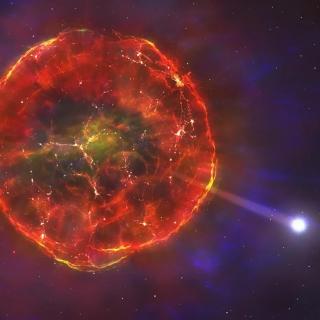
Artist’s impression of a massive binary system. The more evolved star (left) is expanding and interacting with its companion, transferring helium-rich material to it and altering its chemical composition. Credit: Gabriel Pérez Díaz (IAC)
Advertised on
An international team, led by a pre-doctoral researcher at the Instituto de Astrofísica de Canarias (IAC), has revealed that the heaviest chemical elements on the surfaces of the youngest massive stars originate from their more evolved companions. The study has been published in the journal Astronomy and Astrophysics.
‘Throughout their lives, stars produce energy by fusing lighter chemical elements into heavier ones.’ “Stars are the universe’s great factories for chemical elements: as they evolve, they take the lighter ones and fuse them into heavier ones, changing their original composition,” explains Carlos Martínez-Sebastián, a pre-doctoral researcher at the Instituto de Astrofísica de Canarias (IAC) and a PhD student at the University of La Laguna (ULL), who led the study. “The problem is that, in the case of massive stars, we do not understand how these elements reach the surface, where we can observe them."
Massive stars are those with a mass eight times or more that of our Sun, and they are capable of ending their lives in a supernova, leaving behind a neutron star or even a black hole. “They are objects of great interest to astrophysics; although they are few in number, they have very short and violent lives that determine what happens around them. If we want to understand how galaxies evolve, how other stars are born or what the origin of gravitational waves is, we need to understand massive stars,” says Roberto Gamen, co-author of the study and director of the La Plata Institute of Astrophysics (IALP) in Argentina.
For decades, it has been observed that some of these massive stars have far more helium on their surfaces than expected — their second most abundant element — giving rise to what is known as ‘the helium discrepancy’. Classical models of individual stellar evolution were unable to explain this. Now, the team led by the IAC has provided the most robust observational evidence to date that the main cause is interaction with a companion star in binary systems.
"Massive stars are like a barraquito," says Sergio Simón-Díaz, co-author of the study and leader of the IAC’s massive star research group. "At first, it’s structured in layers, but we can only analyse the topmost layer: the milk foam topped with a sprinkling of cinnamon; we know nothing about the liqueur and condensed milk at the bottom." He adds: “However, when you mix it, you can discern all the nuances of its composition and realise that it is not simply a coffee with milk. Similarly, although we can only see the surface of massive stars, this is enough to understand their evolutionary history.”
In the study, published in Astronomy and Astrophysics, the team analysed a sample of 45 single-line spectroscopic binary systems (those in which light from only one of the two stars is detected) containing an O-type star (i.e. a young, massive star). By combining data on the abundance of helium on the surface with orbital parameters such as period and eccentricity, they identified a clear pattern: the stars that accumulated the most helium were precisely those that orbited very closely to their companion, completing their orbit in less than 15 days.
Furthermore, all of them exhibit the characteristic behaviour of so-called ‘runaway’ stars – those that are moving at high speed relative to their surroundings – which suggests that their systems have been disturbed by a previous supernova explosion.
Furthermore, all of them exhibit the characteristic behaviour of so-called ‘runaway’ stars – those that are moving at high speed relative to their surroundings – which suggests that their systems have been disturbed by a previous supernova explosion.
Animation showing the evolution and mass transfer in a massive binary system. It illustrates the key stages of the process: the more evolved star, having expanded, transfers helium-rich gas to its companion, altering the chemical composition of the latter’s surface. The complete sequence shows how this cycle subsequently culminates in the violent supernova explosion of the donor star, a cataclysm that drastically reshapes the system’s orbit or may even destroy it entirely. Credit: Gabriel Pérez Díaz (IAC).
The study suggests that the origin of the anomalous abundance lies in a previous interaction. In a binary system, the more massive star evolves more rapidly, producing much more helium over the same period of time. Furthermore, it also expands more rapidly, which can lead to a transfer of material to its companion. The receiving star accumulates this material on its surface, altering its chemical composition. Subsequently, the more evolved star may explode as a supernova, altering the system’s orbit or even destroying it. “Binary interaction is the most plausible mechanism for explaining the helium enrichment we observe in these stars,” concludes Martínez-Sebastián.
The results have direct implications for theoretical models of stellar evolution, both those describing individual stars and those dealing with binary systems, as they necessitate a review of how chemical mixing and the transport of elements within these stars are modelled. Furthermore, helium enrichment is emerging as a new observational feature for identifying stars that have undergone a binary interaction in the past, even if they no longer show obvious signs of a companion.
This work has drawn on data from the IACOB, MONOS and OWN projects, which focus on the observation of massive stars. Thanks to the OCEANS project — funded by the Marie Skłodowska-Curie Actions (under the Horizon Europe programme) — it has been possible to bring together research staff from the IAC, the University of La Laguna, the La Plata Institute of Astrophysics (CONICET-UNLP), the European Southern Observatory (ESO) and the Centre for Astrobiology (CSIC-INTA), thereby strengthening collaborations between the various institutions.
Article: C. Martínez-Sebastián et al., “The IACOB project. XVIII. Prevalence of short-period binaries among Galactic He-rich O stars”, Astronomy & Astrophysics, 2026. DOI: https://doi.org/10.1051/0004-6361/202661546
Contact at the IAC:
Carlos Martínez-Sebastián, carlos.mtnez.sebastian [at] iac.es (carlos[dot]mtnez[dot]sebastian[at]iac[dot]es)
Sergio Simón-Díaz, segio.simon.diaz [at] iac.es (segio[dot]simon[dot]diaz[at]iac[dot]es)
Gonzalo Holgado, gholgado [at] iac.es (gholgado[at]iac[dot]es)
Carlos Martínez-Sebastián, carlos.mtnez.sebastian [at] iac.es (carlos[dot]mtnez[dot]sebastian[at]iac[dot]es)
Sergio Simón-Díaz, segio.simon.diaz [at] iac.es (segio[dot]simon[dot]diaz[at]iac[dot]es)
Gonzalo Holgado, gholgado [at] iac.es (gholgado[at]iac[dot]es)
Related projects

The IACOB project: A new Era in the Study of Galactic OB Stars
IACOB is an ambitious long-term project whose main scientific goal is to provide an unprecedented empirical overview of the main physical properties of Galactic massive O- and B-type stars which can be used as definitive anchor point for our theories of stellar atmospheres, winds, interiors and evolution of massive stars
Sergio
Simón Díaz
Related news

The Canary Islands Institute of Astrophysics (IAC) is organising the 37th Canary Islands Winter School of Astrophysics, which will take place in San Cristóbal de La Laguna (Tenerife) from 16 to 27 November 2026. This edition will focus on the study of massive stars as tools for understanding processes ranging from star formation to gravitational wave events and core-collapse supernovae. The training programme is aimed at around 75 students on advanced master’s and doctoral programmes, as well as postdoctoral researchers in the early stages of their careers. Over the course of two weeks
Advertised on
Cerca de 80 investigadores de Europa, América, Asia y Australia han participado durante cuatro semanas en un workshop internacional organizado, entre otros, por el investigador del IAC Sergio Simón-Díaz El Instituto de Astrofísica de Canarias (IAC) ha liderado la organización de un encuentro internacional que ha reunido en el Munich Institute for Astro-, Particle and BioPhysics (MIAPbP), en Garching (Alemania), a cerca de 80 investigadores para avanzar en el conocimiento de las estrellas masivas, desde su formación hasta su evolución y muerte. El workshop se celebró del 10 de agosto al 4 de
Advertised on
Researchers from the Instituto de Astrofísica de Canarias (IAC), in collaboration with the Instituto de Ciencias del Cosmos de la Universidad de Barcelona (ICCUB) and the Instituto de Estudios Espaciales de Cataluña (IEEC), have carried out the largest observational study to date on massive runaway stars including rotation and binarity in the Milky Way. This work, recently published in Astronomy & Astrophysics , sheds light on how these stellar “fugitives” are launched into space and what their properties reveal about their intriguing origins. Runaway stars are stars that travel through
Advertised on