
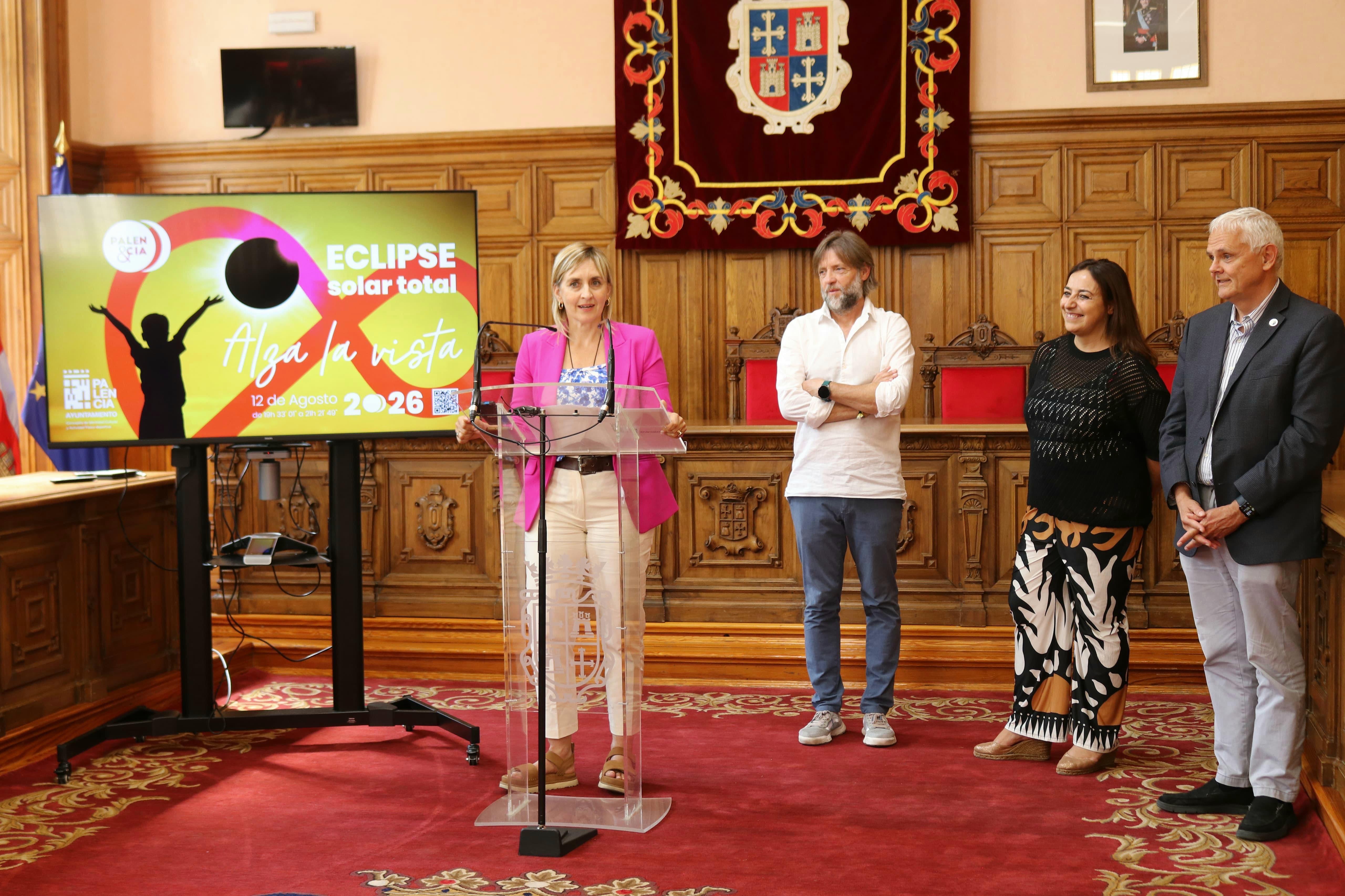
The Plenary Hall of the Palencia City Council hosted the presentation of the program of events surrounding the upcoming eclipse. This ambitious program of educational and artistic events was presented by the mayor of Palencia, Miriam Andrés Prieto; the director of the Canary Islands Institute of Astrophysics (IAC), Valentín Martínez Pillet; the councilor for Cultural Identity, Tourism, and Festivals, Francisco Fernández Asensio; and the deputy director of the IAC, Eva Villaver, a native of Palencia.
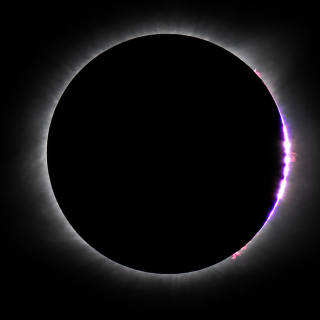
In anticipation of the upcoming eclipse on August 12, Palencia will become Spain’s scientific hub for the event. For three days, leading solar physicists and experts participating in the NATE project—led by the Canary Islands Institute of Astrophysics (IAC) in collaboration with Mohammed VI Polytechnic University (UM6P) in Morocco and the National Solar Observatory (NSO) in the U.S.— with the support of the Canary Islands Government and in collaboration with the Palencia City Council, will prepare the major experiment that will take place during next year’s eclipse in North Africa, and will participate in talks and activities open to the public at various locations throughout the city.
All of this activity will reach its climax on August 12 at Cerro del Otero, where—immediately before, during, and after the eclipse—the teams will demonstrate to the public how they capture images and data, give various talks related to the event, and livestream the Sun’s occultation and subsequent reappearance, leading into the Perseid meteor shower that will follow. In addition, attendees will be able to enjoy the Opus One orchestra, which will perform—for the first time in history—Mike Oldfield’s trilogy: Tubular Bells, Hergest Ridge, and Ommadawn.
Leading Experts
In addition, in the days leading up to the event, other locations around the city—such as the Teatro Principal, the Parque del Salón de Isabel II, and the Plaza Mayor—will host talks and workshops open to the general public on the eclipse and how to observe it safely. This international program also includes talks in Arabic and English and will be complemented by a specific program organized in collaboration with local authorities in the towns of Frómista, Carrión de los Condes, Osorno la Mayor, Villalcázar de Sirga, and Autilla del Pino—the latter as part of the Totality event.
Among the experts participating in the various events are solar physicists Valentín Martínez Pillet (director of the IAC), Kevin Reardon and Sanjay Gosain (NSO), and José Carlos del Toro (Institute of Astrophysics of Andalusia-CSIC). Joining them will be astrophysicists Eva Villaver (a native of Palencia and deputy director of the IAC, as well as a member of the European Space Agency’s Space Science Advisory Committee), Jorge Pérez-Gallego (coordinator of the NATE project), and Youssef Moulane (UM6P). In addition, a large team of experts from the IAC will round out the ambitious program.
Inclusive Eclipse
In addition, using the LightSound tool—in collaboration with the Inclusive Eclipse project of the Institute of Space Sciences (ICE-CSIC)—people with visual impairments will be able to enjoy the event at Cerro del Otero through a designated area where they will be provided with the necessary technological tools.
NATE: Science That Brings People Together Under Eclipses
The NATE project, whose key phase will be launched in Palencia, will establish a coordinated network of stations in Morocco during the total solar eclipse on August 2, 2027. These stations will feature telescopes operated by teams composed of high school and college students and teachers from Spain, Morocco, and the United States, as well as astronomers and engineers from the IAC and UM6P. Prior to that, a crucial test and training session for the various technical and human teams will take place this year in Palencia during the eclipse.
While the short duration of the 2026 eclipse—just over a minute and a half in the case of Palencia—and its low elevation above the horizon—between twelve and two degrees across Spain—are not ideal for science, they are ideal for preparing experiments. The totality phase of the 2027 eclipse in Morocco will last about four minutes at each location—with an optimal altitude of up to forty degrees—and the combined data set from the experiment will reveal how the solar corona changes during the extended period it will be visible at these locations (about ten minutes).
These data may yield new scientific findings on the dynamics of magnetic fields and plasma in this region of the solar corona, and the sequence of images will provide a unique perspective on the eclipse. Furthermore, the necessary data processing will train the participating teams in techniques applicable to a wide variety of technical research areas. The study of the solar corona—visible to the naked eye from Earth’s surface only during total solar eclipses—is essential for understanding space weather, as it is the source of solar flares and coronal mass ejections. Understanding these phenomena allows us not only to better comprehend our star but also to predict and mitigate geomagnetic storms that impact and damage our terrestrial and space-based technologies.
All of this work, however, will only be possible with prior training in Palencia. For this reason, NATE stands out as a major international scientific cooperation initiative spanning two eclipses, one that not only brings together three countries, scientists, and students in a citizen science project but also forges a link between depopulated regions of Spain, the outermost islands, and North Africa, thereby placing them at the forefront of scientific interest through the collection of relevant data that will bear fruit in the coming years.