

The free-registration initiative brings together specialists from research centres, universities, institutions and companies at IACTEC on 2 and 3 July to address the role of astrophysics as a scientific, technological and economic driver.
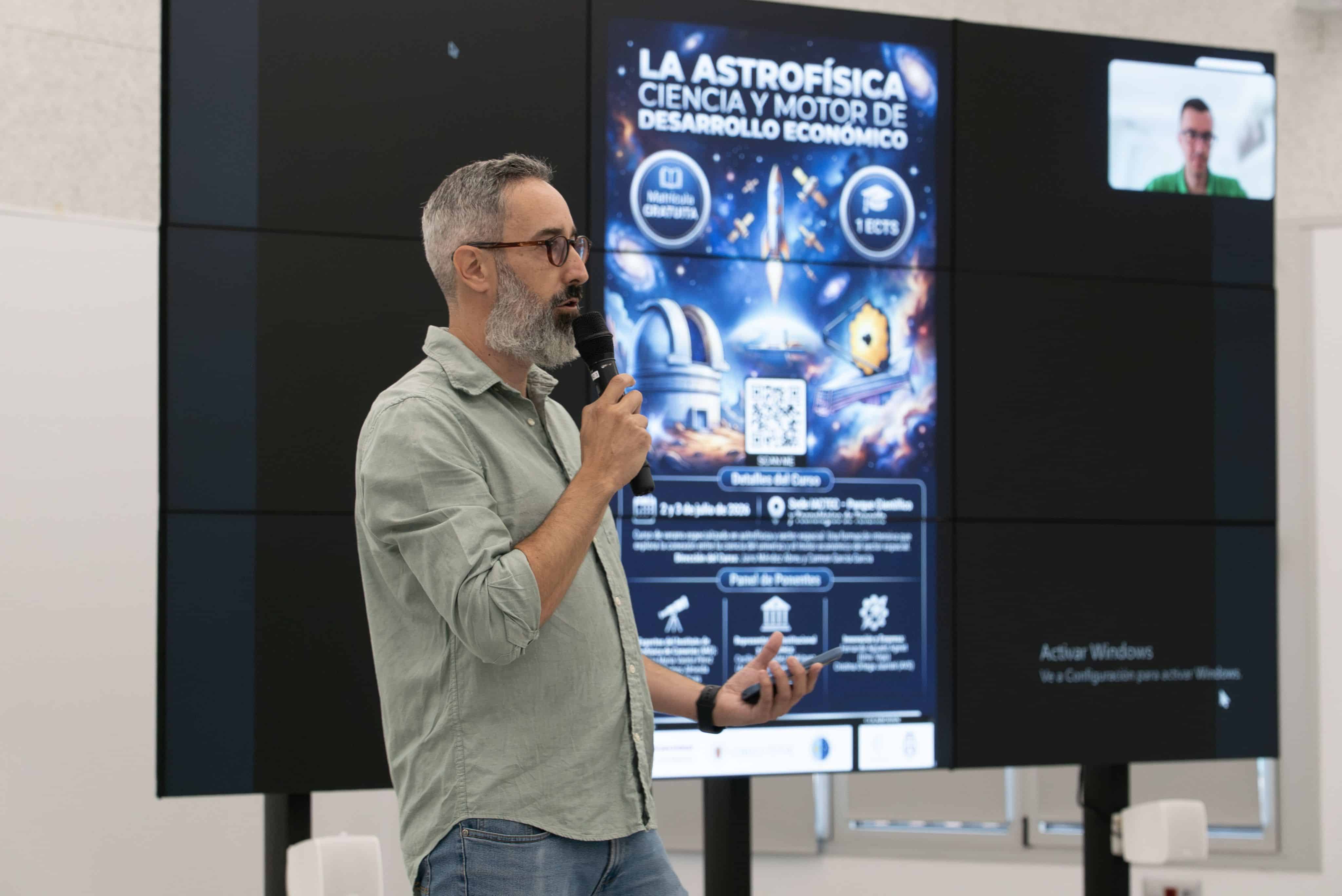
The IACTEC building, located in the Las Mantecas Technology Park in La Laguna, is hosting from today until tomorrow, 3 July, the course "Astrophysics as a science and driver of economic development". The initiative forms part of the Summer Courses of the Universidad Complutense de Madrid in San Lorenzo de El Escorial and, for the first time, is being jointly organised with the Universidad de La Laguna (ULL) and the Instituto de Astrofísica de Canarias (IAC), with the collaboration of the Cabildo de Tenerife and the CELESTE project.
The course, which is free to register for and open to anyone interested, is directed by Jairo Méndez-Abreu, IAC researcher and permanent lecturer at the ULL, together with Carmen García García, Head of the Local Development Area of Robledo de Chavela Town Council.
This first collaboration with the Universidad Complutense de Madrid brings some of the most significant advances in modern astrophysics closer to the public and shows how astronomical research drives technological development, innovation and the creation of new economic opportunities, especially in a territory such as the Canary Islands, an international benchmark for observing the Universe and with growing potential in the space sector.
Over the two days, the programme offers an up-to-date overview of our knowledge of the Universe, from the study of the Sun, stars and galaxies to the search for life on other planets, highlighting the fundamental role played by major ground-based and space observatories and the development of cutting-edge scientific instrumentation.
The course also devotes a significant part of its programme to the socio-economic impact of astrophysics and the space sector. The sessions address the opportunities these fields offer to generate highly qualified employment, promote technology transfer and consolidate a knowledge-based economy, both in Spain and in the Canary Islands.
The Instituto de Astrofísica de Canarias plays a prominent role in the academic programme. Speakers include Cristina Ramos Almeida, Jorge García Rojas, Savita Mathur, José Alberto Rubiño Martín and Rafael Rebolo, who share the latest advances in areas such as galaxy evolution, stellar physics, planetary nebulae, cosmology and the scientific and technological opportunities linked to the space sector.
The course has been opened by Juan José Martínez Díaz, Councillor for Innovation, Research and Development at the Cabildo de Tenerife; Valentín Martínez Pillet, Director of the IAC; and Abel López Díez, Director of the Secretariat for University Extension at the ULL. The programme also includes the participation of representatives from the Spanish Space Agency, the Universidad de Vigo, the company AVS and the ULL, who analyse the growth of the Spanish space industry, the new professional profiles required by the sector and the opportunities offered by the Canary Islands for the development of space-related activities.
The course will close with a round table on the challenges and opportunities of astrophysics as a driver of economic development, with the participation of representatives from research, academia and institutions linked to the space sector.
With this initiative, the IAC and the Universidad de La Laguna reinforce their commitment to science outreach, specialised training and the promotion of an innovation ecosystem that positions the Canary Islands as an international benchmark in both astrophysics and space technologies.
More information:
· Programme
· Video
Contact at the IAC:
Jairo Méndez-Abreu, jairo [at] iac.es (jairo[at]iac[dot]es)