
The Instituto de Astrofísica de Canarias (IAC) has contributed to the discovery of And XXXVI, a new ultra-faint dwarf galaxy situated in the vicinity of Andromeda (M31), the Milky Way’s large neighbouring galaxy. The discovery, which reveals one of the faintest satellite galaxies identified to date around Andromeda, was made possible by observations carried out with the Gran Telescopio Canarias (GTC) and the OSIRIS+ instrument. The results of the study are published in the journal Astronomy & Astrophysics.
Ultra-faint dwarf galaxies are among the smallest and dimmest galaxies known. Formed during the earliest stages of the Universe, they are considered fossil records of the first galaxies and are thought to be dominated by dark matter. As such, they provide a unique window into galaxy formation in the early Universe and offer valuable tests of dark matter models.
Researchers at the Instituto de Astrofísica de Andalucía (IAA-CSIC) have led the discovery of a new ultra-faint dwarf galaxy in the vicinity of Andromeda (M31), the nearest massive galaxy to the Milky Way. The newly identified system, named Andromeda XXXVI (And XXXVI), appears to be a member of Andromeda’s satellite galaxy population.
“Our study suggests that And XXXVI is an extremely old galaxy, around 12.5 billion years old, and remarkably poor in heavy elements,” says Joanna Sakowska, researcher at IAA-CSIC and lead author of the study. “However, observations with space telescopes such as Hubble will be needed to determine its distance, age and chemical composition with greater precision.”
“What is already clear is that And XXXVI is one of the faintest satellite galaxies discovered around Andromeda to date,” she adds.
A LABORATORY FOR STUDYING GALAXY FORMATION
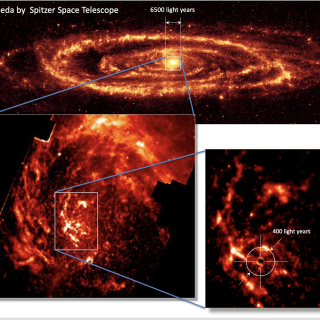
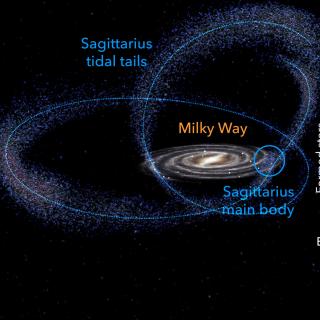
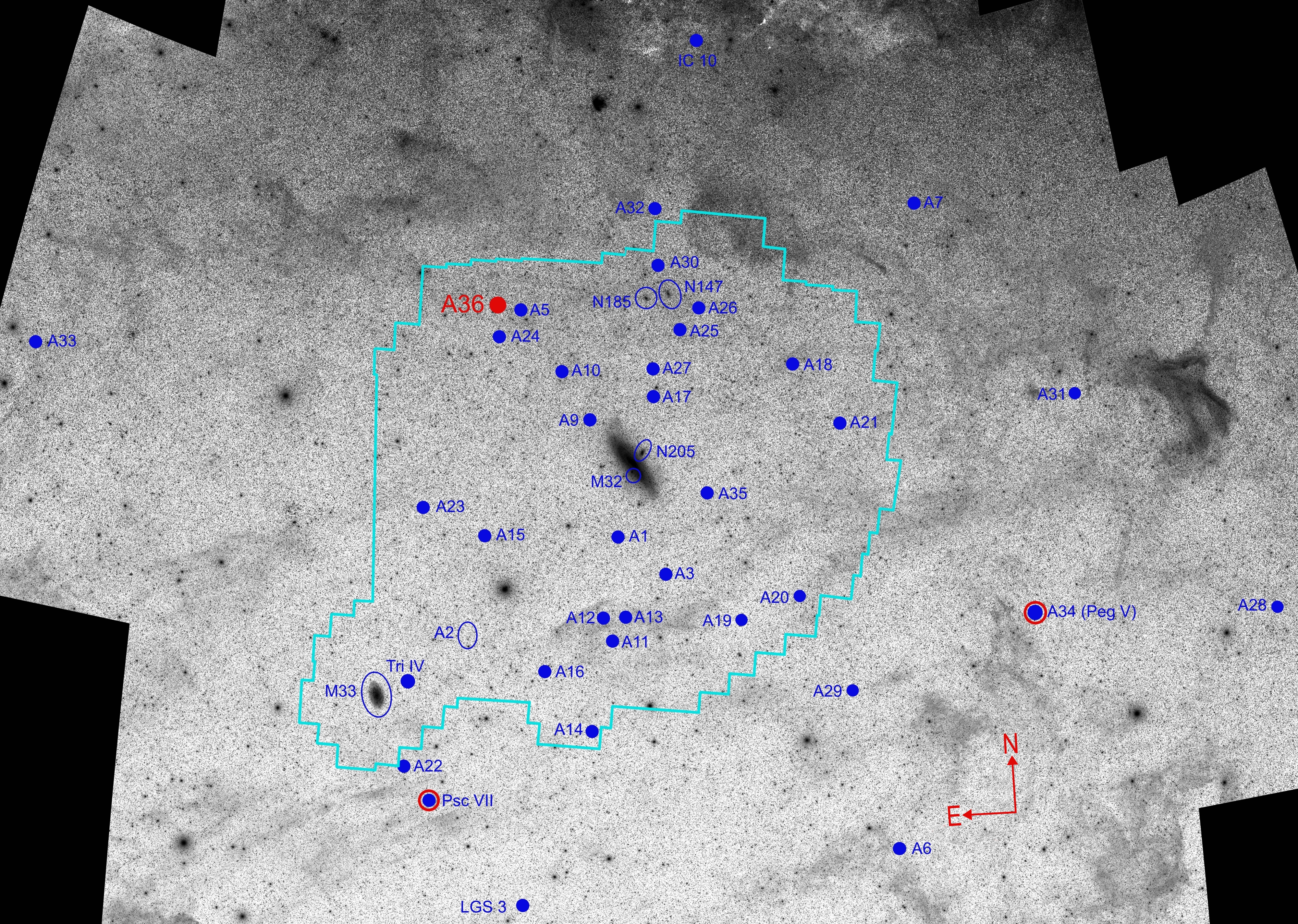
Located approximately 2.5 million light-years from Earth, the Andromeda Galaxy is the closest giant spiral galaxy to the Milky Way. Like our own galaxy, it is surrounded by numerous dwarf satellite galaxies that orbit under its gravitational influence.
These systems are valuable laboratories for studying how the first galactic structures formed and evolved. They also provide key tests of the standard cosmological model, ΛCDM (Lambda Cold Dark Matter), which describes how galaxies emerged from dark matter after the Big Bang. Current theoretical predictions suggest that Andromeda may host as many as 90 satellite galaxies: significantly more than have been identified so far.
“We currently know of around 40 dwarf satellite galaxies around Andromeda, of which only about 15 are classified as ultra-faint,” explains Sakowska. “Each new discovery, such as Andromeda XXXVI, is important because it suggests that we may still be seeing only the tip of the iceberg of a much larger population of extremely faint galaxies.”
THE DISCOVERY OF ANDROMEDA XXXVI
Andromeda XXXVI was first identified by the astrophotographer and amateur astronomer Giuseppe Donatiello while examining images from the Pan-Andromeda Archaeological Survey (PAndAS), carried out with the Canada-France-Hawaii Telescope (CFHT). The object appeared as a faint diffuse feature in which individual stars could already be distinguished. Donatiello subsequently included it in a list of candidate galaxies that he shared with Joanna Sakowska (IAA-CSIC) and David Martínez-Delgado (CEFCA) for further investigation.
And XXXVI is the fourth dwarf galaxy discovered in the Andromeda region within this project in the last decade. The result highlights the enormous potential contribution of amateur astronomers when they have adequate training and access, from their own homes, to public images from large-scale sky surveys. “Our list of possible candidates for these ‘lost galaxies’ already exceeds a dozen, and we are eager to obtain observing time on telescopes with apertures between 8 and 10 meters to confirm them,” says Martínez-Delgado.
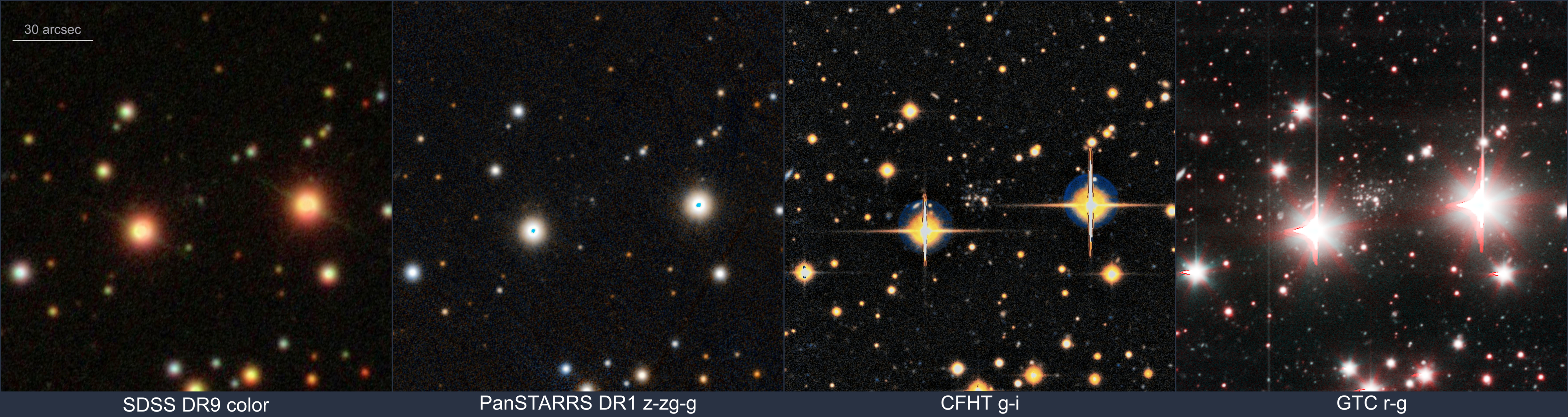
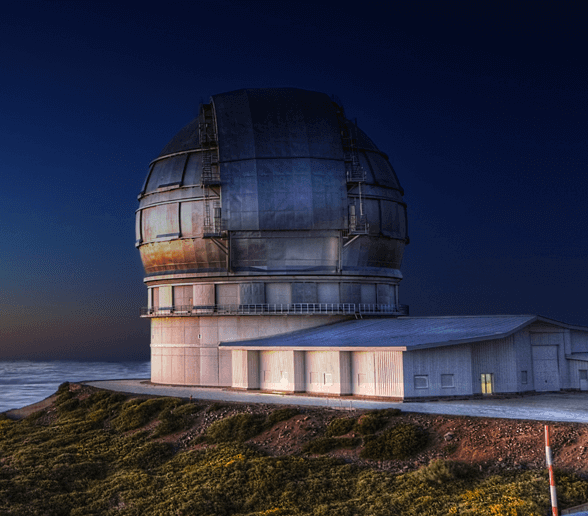
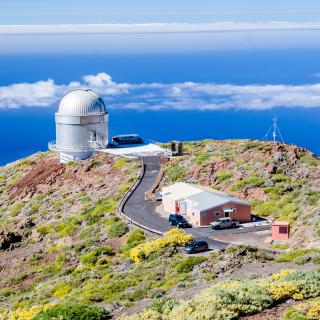
After selecting Andromeda XXXVI for further study, the team secured Director's observing Time on the Gran Telescopio Canarias (GTC) where they used the OSIRIS+ instrument, owned by the Instituto de Astrofísica de Canarias (IAC), to obtain much deeper images. These observations allowed them to distinguish individual stars within the galaxy's faint, diffuse light. However, Andromeda XXXVI proved to be an exceptionally faint object: the research team was only able to identify about 46 stars associated with it.
“This scarcity of stars makes it extremely difficult to apply the usual methods for measuring galactic distances, which are usually based on larger stellar populations,” says Matteo Monelli, a researcher at the IAC and the University of La Laguna (ULL) during the course of this study and currently a researcher at INAF, as well as a co-author of the paper.
To overcome this limitation, the team compared the observed stars with theoretical stellar evolution models known as isochrones, which predict the colours and brightness of stars of a given age and chemical composition. “Assuming that And XXXVI lies at approximately the same distance as Andromeda, the observations and models match remarkably well,” Sakowska explains. “This strongly suggests that it is indeed a satellite galaxy of M31.”
Discovering ultra-faint dwarf galaxies is extremely difficult: their small size and low luminosity mean they can only be detected in our immediate cosmic neighbourhood. “Each of these discoveries offers us an exceptional opportunity to study how galaxies form at such extreme mass scales, as well as to investigate the distribution of dark matter. Therefore, we expect Andromeda XXXVI to be a subject of study in the coming years,” concludes Joanna Sakowska (IAA-CSIC).
Artículo: Joanna D. Sakowska, et al. “Andromeda XXXVI: discovery of a new ultra-faint dwarf galaxy towards M31”, A&A, 2026. DOI: https://doi.org/10.1051/0004-6361/202660151