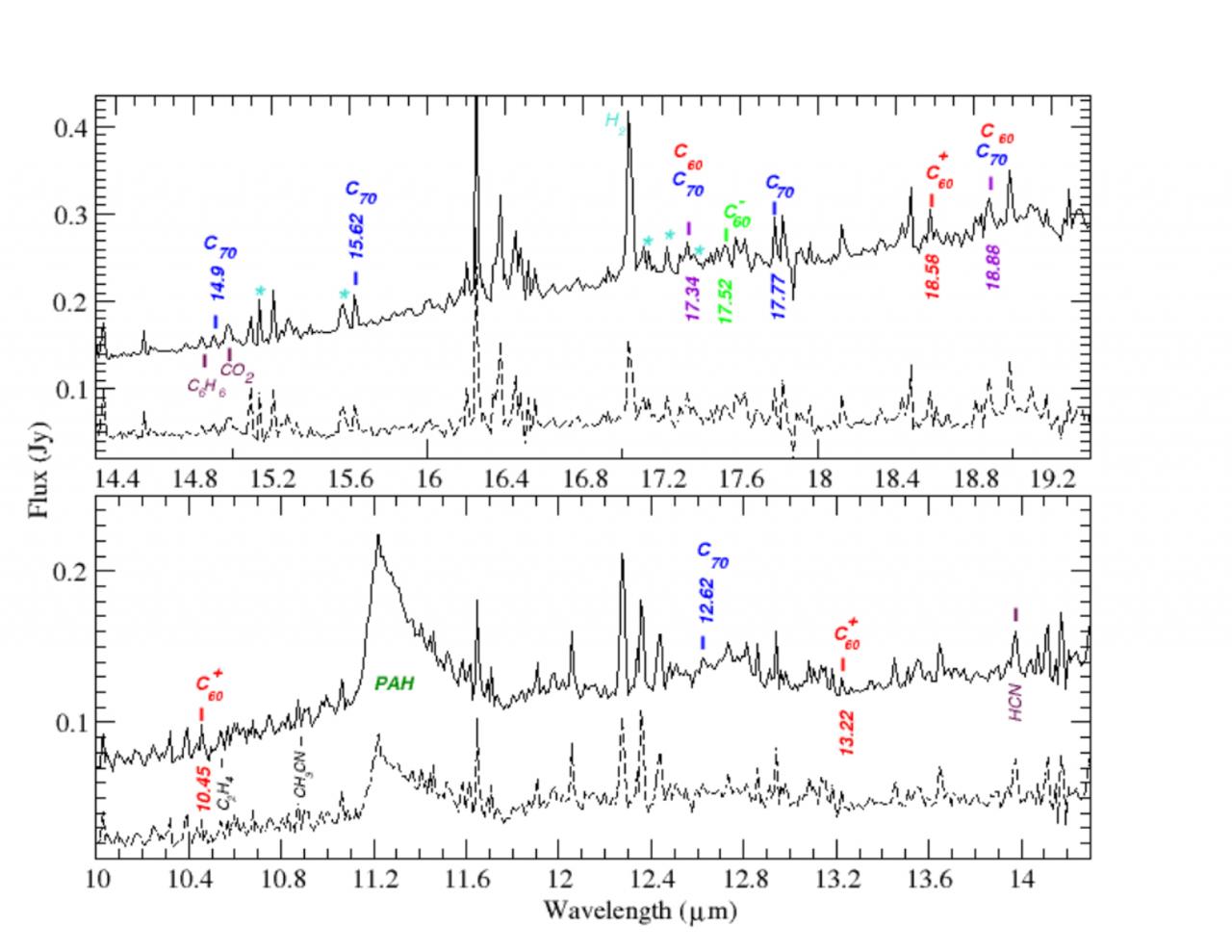
We present the detection of fullerenes C60 and C70 in the star-forming region IC 348 of the Perseus molecular cloud. Mid-IR vibrational transitions of C60 and C70 in emission are found in Spitzer IRS spectra of individual stars (LRLL 1, 2, 58), in the averaged spectrum of three other cluster stars (LRLL 21, 31, and 67) and in spectra obtained at four interstellar locations distributed across the IC 348 region. Fullerene bands appear widely distributed in this region with higher strength in the lines of sight of stars at the core of the cluster. Emission features consistent with the three most intense bands of the C60+ and with one of C60- are also found in several spectra, and if ascribed to these ionized species it would imply ionization fractions at 20 and 10 per cent, respectively. The stars under consideration host protoplanetary discs, however the spatial resolution of the spectra is not sufficient to disentangle the presence of fullerenes in them. If fullerene abundances in the cloud were representative of IC 348 protoplanetary discs, C60, the more abundant of the two species, could host 0.1 per cent of the total available carbon in the discs. This should encourage dedicated searches in young discs with upcoming facilities such as the JWST. Fullerenes provide a reservoir of pentagonal and hexagonal carbon rings which could be important as building blocks of prebiotic molecules. Accretion of these robust molecules in early phases of planet formation may contribute to the formation of complex organic molecules in young planets.
Averaged Spitzer spectra in the MIR of LRLL 21, 31 and 67, solid line and 4 interstellar locations (broken line) in IC348. The location of Fullerenes, organic molecules and water are indicated.
It may interest you
-
Ultra-faint dwarf galaxies, among the tiniest and faintest galaxies known, may hold the key to understanding one of the Universe’s biggest mysteries: the true nature of dark matter. A new study reveals that even a single collision between dark matter particles every 10 billion years — roughly the age of the Universe — is enough to explain the dark matter cores observed in these small systems. These galaxies, which contain only a few thousand stars, are dominated by dark matter and have relatively simple evolutionary histories. That makes them ideal cosmic laboratories for testing theoriesAdvertised on -
El Instituto de Astrofísica de Canarias reúne a su personal investigador y técnico para presentar los resultados más destacados del último año y abordar los retos científicos de la próxima década El Instituto de Astrofísica de Canarias (IAC) ha celebrado hoy la XVII edición del “Día de Nuestra Ciencia”, un encuentro anual de carácter interno que ha reunido a personal investigador, técnico y de apoyo a la investigación en la sede de IACTEC, en La Laguna. La jornada se ha consolidado como un espacio para compartir los avances científicos y tecnológicos más relevantes desarrollados en el últimoAdvertised on -
The rocky planet GJ 1132 b, with Earth-like mass and radius, is a prime candidate for atmospheric studies. Previous observations with Hubble and JWST yielded conflicting results about its atmosphere. This study used three transit observations with the CRIRES+ instrument to search for He i, HCN, CH₄, and H₂O in GJ 1132 b's atmosphere. No clear atmospheric signals were detected, but upper limits for CH₄, HCN, and H₂O were established. The results suggest that if GJ 1132 b has an atmosphere, it is not dominated by hydrogen. The work highlights the challenges of detecting high molecular weightAdvertised on