
Bibcode
Rodrigues, J.; Barros, S. C. C.; Santos, N. C.; Davoult, J.; Attia, M.; Castro-González, A.; Sousa, S. G.; Demangeon, O. D. S.; Hobson, M. J.; Bossini, D.; Ziegler, C.; Faria, J. P.; Adibekyan, V.; Lovis, C.; Lavie, B.; Damasso, M.; Silva, A. M.; Suárez Mascareño, A.; Pepe, F.; Bouchy, F.; Alibert, Y.; González Hernández, J. I.; Sozzetti, A.; Allende Prieto, C.; Cristiani, S.; Palle, E.; D'Odorico, V.; Ehrenreich, D.; Figueira, P.; Stassun, K. G.; Génova Santos, R.; Lo Curto, G.; Martins, C. J. A. P.; Mehner, A.; Micela, G.; Molaro, P.; Nunes, N. J.; Poretti, E.; Rebolo, R.; Udry, S.; Zapatero Osorio, M. R.
Bibliographical reference
Astronomy and Astrophysics
Advertised on:
3
2025
Journal
Citations
3
Refereed citations
3
Description
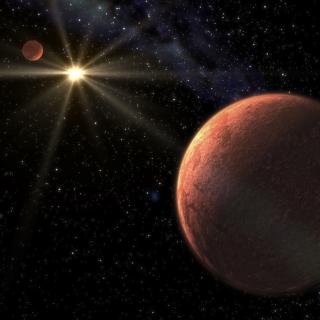
Context. One of the goals of the ESPRESSO guaranteed time observations (GTOs) at the ESO 8.2 m telescope is to follow up on candidate planets from transit surveys such as the TESS mission. High-precision radial velocities are required to characterize small exoplanets. Aims. We intend to confirm the existence of a transiting super-Earth around the bright (V=9.74) K0-type star TOI-512 (TIC 119292328) and provide a characterization. Methods. Combining photometric data from TESS and 37 high-resolution spectroscopic observations from ESPRESSO in a joint Markov chain Monte Carlo analysis, we determined the planetary parameters of TOI-512b and characterized its internal structure. Results. We find that TOI-512b is a super-Earth, with a radius of 1.54 ± 0.10 R⊕ and mass of 3.57‑0.55+0.53 M⊕, on a 7.19‑6.1·10‑5+7.10‑5 day orbit. This corresponds to a bulk density of 5.62‑1.28+1.59 g cm‑3. Our interior structure analysis presents a small inner core representing 0.13‑0.11+0.13 of the solid mass fraction for the planet, surrounded by a mantle with a mass fraction of 0.69‑0.22+0.20, and an upper limit of the water layer of 0.16. The gas mass below 10‑8.93 indicates a very small amount of gas on the planet. We find no evidence of the second candidate found by the TESS pipeline, TOI-512.02, neither in TESS photometry, nor in the ESPRESSO radial velocities. The low stellar activity makes it an interesting transmission spectroscopy candidate for future-generation instruments. ★Based on Guaranteed Time Observations collected at the European Southern Observatory by the ESPRESSO Consortium under ESO programmes 106.21M2.007, 108.2254.002, 108.2254.005, and 108.2254.006.
Related projects

Exoplanets and Astrobiology
The search for life in the universe has been driven by recent discoveries of planets around other stars (known as exoplanets), becoming one of the most active fields in modern astrophysics. The growing number of new exoplanets discovered in recent years and the recent advance on the study of their atmospheres are not only providing new valuable
Enric
Pallé Bago
Very Low Mass Stars, Brown Dwarfs and Planets
Our goal is to study the processes that lead to the formation of low mass stars, brown dwarfs and planets and to characterize the physical properties of these objects in various evolutionary stages. Low mass stars and brown dwarfs are likely the most numerous type of objects in our Galaxy but due to their low intrinsic luminosity they are not so
Rafael
Rebolo López