
Bibcode
Moreno-Insertis, Fernando; Hansteen, Viggo H.; Nóbrega-Siverio, Daniel
Bibliographical reference
The Astrophysical Journal
Advertised on:
12
2025
Journal
Citations
3
Refereed citations
3
Description
We present a radiation-magnetohydrodynamics (RMHD) simulation of a magnetic cancellation event. The model is calculated with the Bifrost code and spans from the uppermost convection zone to the corona. The cancellation occurs between the positive polarity of an emerged magnetic bipole and a preexisting negative polarity. We try both to understand the RMHD aspects as well as to carry out comparison to observations, in part via spectral synthesis of optically thick photospheric and chromospheric lines using the RH1.5D code, and optically thin coronal ones. The reconnection between the opposite flux systems takes place at chromospheric heights without null points. Sharp V-shaped upward-moving field lines and highly warped downward-moving post-reconnection loops are created. The chromospheric reconnection is in full swing when the colliding magnetic patches are still separated by a granular cell at the photosphere. In a later phase, photospheric cancellation takes place with submergence of the closed magnetic loops linking the opposite polarities. We carry out comparisons with the observations of the photospheric magnetic flux loss rates, as well as of the horizontal magnetic field and vertical velocity at the polarity inversion line. The reconnection outflows cause intensity brightenings, jets, and different spectral features in the synthesized chromospheric spectral lines, strongly reminiscent of those found in recent observations. Coherent, twisted magnetic flux ropes are created by the flows associated with the process. Including coronal levels is crucial for proper modeling, even if no major ejection or brightening is produced in the corona in this event.
Related projects
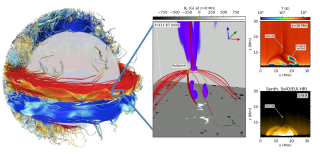
The Whole Sun Project: Untangling the complex physical mechanisms behind our eruptive star and its twins
The Sun is a magnetically active star with violent eruptions that can hit Earth´s magnetosphere and cause important perturbations in our technology-dependent society. The objective of the Whole Sun project is to tackle in a coherent way for the first time key questions in Solar Physics that involve as a whole the solar interior and the atmosphere
Fernando
Moreno Insertis

Numerical Simulation of Astrophysical Processes
Numerical simulation through complex computer codes has been a fundamental tool in physics and technology research for decades. The rapid growth of computing capabilities, coupled with significant advances in numerical mathematics, has made this branch of research accessible to medium-sized research centers, bridging the gap between theoretical and