
Bibcode
Barclay, T.; Greiss, S.; Carrera, R.; Naslim, N.; Karjalainen, R.; Jeffery, C. S.; Ramsay, G.; Hakala, P.; Brooks, A.
Bibliographical reference
Monthly Notices of the Royal Astronomical Society, Volume 429, Issue 4, p.3207-3213
Advertised on:
3
2013
Citations
16
Refereed citations
14
Description
Optical spectroscopy of the blue star KIC 10449976 shows that it is an
extremely helium-rich subdwarf with effective temperature
Teff = 40 000 ± 300 K and surface gravity log g = 5.3
± 0.1. Radial-velocity measurements over a 5 d time-scale show an
upper variability limit of ≈50 ± 20 km s-1. Kepler
photometry of KIC 10449976 in both long and short cadence modes shows
evidence for a periodic modulation on a time-scale of ≈3.9 d. We have
examined the possibility that this modulation is not astrophysical but
conclude that it is most likely real. We discuss whether the modulation
could be caused by a low-mass companion, by stellar pulsations or by
spots. The identification of any one of these as cause has important
consequences for understanding the origin of helium-rich subdwarfs.
Related projects
Milky Way and Nearby Galaxies
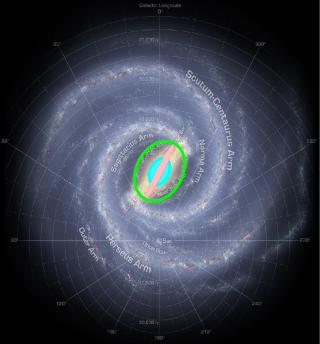
The overall aim of the project is to study the morphology, stellar populations, kinematics and dynamics (including formation and evolution) of the Milky Way and its satellite galaxies and other Local Group galaxies. The project can be divided into two main lines: I. Structure of the Milky Way and nearby galaxies. The detailed study of the
Martín
López Corredoira