
Bibcode
Rodrigues, Gabriel; Cuesta, Antonio J.; Alcaniz, Jailson; Resco, Miguel Aparicio; Maroto, Antonio L.; Masip, Manuel; Rodrigues, Jamerson G.; dos Santos, Felipe B. M.; de Cruz Pérez, Javier; García-Farieta, Jorge Enrique; Siqueira, Clarissa; Qin, Fuxing; Wang, Yuting; Zhao, Gong-Bo; Hernández-Monteagudo, Carlos; Marra, Valerio; Abramo, Raul; Benítez, Narciso; Bonoli, Silvia; Carneiro, Saulo; Cenarro, Javier; Cristóbal-Hornillos, David; Dupke, Renato; Ederoclite, Alessandro; Hernán-Caballero, Antonio; López-Sanjuan, Carlos; Marín-Franch, Antonio; de Oliveira, Claudia Mendes; Moles, Mariano; Sodré, Laerte, Jr.; Taylor, Keith; Varela, Jesús; Ramió, Héctor Vázquez
Bibliographical reference
Journal of Cosmology and Astroparticle Physics
Advertised on:
12
2025
Citations
4
Refereed citations
4
Description
The large-scale structure survey J-PAS is taking data since October 2023. In this work, we present a forecast based on the Fisher matrix method to establish its sensitivity to the sum of the neutrino masses. We adapt the Fisher Galaxy Survey Code (FARO) to account for the neutrino mass under various configurations applied to galaxy clustering measurements. This approach allows us to test the sensitivity of J-PAS to the neutrino mass across different tracers, with and without non-linear corrections, and under varying sky coverage. We perform our forecast for two cosmological models: Λ CDM + ∑mν and w 0 wa CDM + ∑mν . We combine our J-PAS forecast with Cosmic Microwave Background (CMB) data from the Planck Collaboration and Type Ia supernova (SN) data from Pantheon Plus. Our analysis shows that, for a sky coverage of 8,500 square degrees, J-PAS galaxy clustering data alone will constrain the sum of the neutrino masses to an upper limit at 95% C.L of ∑mν < 0.32 eV for the Λ CDM + ∑mν model, and ∑mν < 0.36 eV for the w 0 wa CDM + ∑mν model. When combined with Planck data, the upper limit improves significantly. For J-PAS+Planck at 95% C.L, we find ∑mν < 0.061 eV for the Λ CDM + ∑mν model, and for J-PAS+Planck+Pantheon Plus, we obtain ∑mν < 0.12 eV for the w 0 wa CDM + ∑mν model. These results demonstrate that J-PAS clustering measurements can play a crucial role in addressing challenges in the neutrino sector, including potential tensions between cosmological and terrestrial measurements of the neutrino mass, as well as in determining the mass ordering.
Related projects
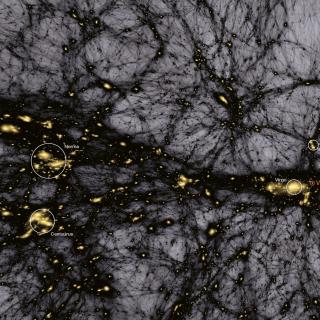
Cosmology with Large Scale Structure Probes
The Cosmic Microwave Background (CMB) contains the statistical information about the early seeds of the structure formation in our Universe. Its natural counterpart in the local universe is the distribution of galaxies that arises as a result of gravitational growth of those primordial and small density fluctuations. The characterization of the
Francisco Shu
Kitaura Joyanes