
Bibcode
Sánchez, S. F.; Muñoz-Tuñón, C.; Sánchez Almeida, J.; González-Martín, O.; Pérez, E.
Bibliographical reference
Astronomy and Astrophysics
Advertised on:
12
2025
Journal
Citations
5
Refereed citations
3
Description
Context. Diagnostic diagrams based on optical emission lines, especially classical BPT diagrams, have long been used to distinguish the dominant ionisation mechanisms in galaxies. However, these methods suffer from degeneracies and limitations, particularly when applied to complex systems such as galaxies, where multiple ionisation sources coexist. Aims. We aim to critically assess the effectiveness of commonly used diagnostic diagrams in identifying star-forming galaxies, retired galaxies (RGs), and active galactic nuclei (AGNs). We also explore alternative diagnostics and propose a revised classification scheme to reduce misclassifications and better reflect the physical mechanisms ionizing gas in galaxies. Methods. Using a comprehensive sample of nearby galaxies from the NASA-Sloan Atlas (NSA) cross-matched with Sloan Digital Sky Survey (SDSS) spectroscopic data, we defined archetypal subsamples of late-type and star-forming galaxies, early-type and retired galaxies, and multiwavelength-selected AGNs. We evaluated their distribution across classical and more recent diagnostic diagrams, including the WHaN, WHaD, and a newly proposed WHaO diagram, which combine Hα equivalent width with additional indicators (N II/Hα, σHα and O III/O II, respectively). We carried out a quantitative comparison of the resulting classification across multiple schemes. Results. Classical BPT diagrams systematically overestimate the number of star-forming galaxies (∼10%) and misclassify a significant fraction of AGNs (up to 45%) and RGs (up to 100%). Diagrams incorporating the equivalent width of Hα, such as WHaN, WHaD, or WHaO, yield more reliable separations (with ∼20% of AGNs and ∼15% of RGs erroneously classified). A new classification scheme based on EW(Hα) thresholds and concordant WHaD/WHaO results achieves an improved level of purity for all classes (with ∼8─25% sources erroneously classified) and a better alignment with known physical properties. Conclusions. The widely used BPT-based classifications fail to accurately distinguish between ionisation mechanisms, especially in galaxies hosting low-luminosity AGNs or retired stellar populations. Updated schemes incorporating EW(Hα) and complementary diagnostics, despite their respective limitations, provide a more accurate view of galaxy ionisation and should be adopted in future studies of galaxy populations and evolution.
Related projects
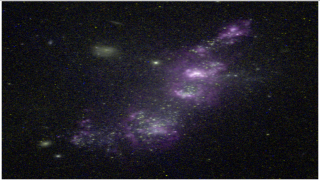
Starbursts in Galaxies GEFE
Starsbursts play a key role in the cosmic evolution of galaxies, and thus in the star formation (SF) history of the universe, the production of metals, and the feedback coupling galaxies with the cosmic web. Extreme SF conditions prevail early on during the formation of the first stars and galaxies, therefore, the starburst phenomenon constitutes a
Casiana
Muñoz Tuñón